U.S. Customs Broker License Examination (CBLE), Practice Exams
Full practice exam (Exam Mode)
Test-day conditions: a full 80-question exam, no feedback until you submit, a score for each subject area so you can see your weak areas, and a full question-by-question review at the end.
The real exam requires 75% to pass — 60 of 80. Each subject area is scored separately here so you know exactly where you stand.
Revision Mode
Revise with instant feedback: the moment you pick an answer you see whether it was right, with the regulation-cited explanation. Untimed — ideal before you sit a mock test. Questions you miss keep coming back until you know them.
Subject areas & your progress
Unlock the full question bank
The free sample is one full practice exam's worth of questions, with at least 5 in every subject area so you can revise each topic: 85 questions in all. The full bank is all 381 questions from CBP's five most recent published sittings, with CBP's official answers, plus 493 authored questions, every one with a plain-English explanation citing the governing regulation. $49, one time, lifetime access on up to 3 devices.
✓ Real past-exam questions · new sittings added free · up to 3 devices · no subscription · no account needed
Score history
The real exam: key facts
| Delivered by | U.S. Customs and Border Protection (CBP) |
|---|---|
| Official exam | Customs Broker License Examination (CBLE) |
| Questions | 80 multiple-choice questions |
| Time | 4 hours 30 minutes |
| Passing score | 75% |
| Exam fee | $390 per sitting (19 CFR 111.96(a)) |
| Pre-licensing or eligibility | Not required |
| Book your exam | cbp.gov/trade/programs-administration/customs-brokers/license-examination-notice-examination |
Checked 11 October 2026 from the official sources below. Rules and fees change, so confirm with U.S. Customs and Border Protection (CBP) before you book.
Official sources
- cbp.gov/trade/programs-administration/customs-brokers/license-examination-notice-examination/general-cble-information
- cbp.gov/trade/programs-administration/customs-brokers/frequently-asked-questions
- cbp.gov/trade/programs-administration/customs-brokers/license-examination-notice-examination
- ecfr.gov/current/title-19/chapter-I/part-111/subpart-B/section-111.13
- ecfr.gov/current/title-19/chapter-I/part-111/subpart-B/section-111.11
- content.govdelivery.com/accounts/USDHSCBP/bulletins/4076614
- law.cornell.edu/cfr/text/19/111.96
How Manifest Prep compares
Manifest is a $49 bank built on CBP's recent published exams, not a taught course. Here is how it compares with the CBLE courses candidates usually consider, including where they are the better choice. See the comparison with Global Training Center, ST&R, LACBFFA exam preparation course and others.
Review
Frequently asked questions
How is the Customs Broker License Examination structured?
The CBLE is 80 multiple-choice questions (4 options each) over 4.5 hours, and requires 75% to pass. It is an OPEN BOOK exam: you may bring the HTSUS, 19 CFR and the listed CBP directives. Questions span 7 subject areas; this bank mirrors the weighting of recent sittings.
What score do I need to pass?
75 percent — that is 60 of 80 questions. Revise each subject area to that level in Revision Mode, then sit a full timed simulation in Exam Mode before exam day.
Are these real CBLE exam questions?
Partly, and the site labels which is which. 381 are verbatim questions from official past Customs Broker License Examinations with CBP's own keyed answers, from the five most recent sittings CBP has published (May 2024 to April 2026). The other 493 are written by us against the same regulations, because past papers do not cover every testable provision. Both carry explanations citing 19 CFR or the HTSUS.
How many practice questions are included?
The full bank contains 874 questions with explanations, drawn from consecutive past sittings. The free sample is one full practice exam's worth of questions, with at least 5 in every subject area so you can revise each topic: 85 questions in all.
It is open book — why practise at all?
Because open book is exactly why candidates fail. The pass rate is typically well under half. You have about 3½ minutes per question and roughly 4,000 pages of reference material; the skill being tested is knowing where a rule lives and finding it fast. Every explanation here cites the provision, so you are drilling navigation, not memorisation.
What does access cost?
$49, one time, for lifetime access — including the ~80 new questions we add after each April and October sitting. No subscription.
Can I use it on more than one device?
Yes. One purchase works on up to 3 of your devices. Your progress is saved on each device.
Do I need to create an account?
No. The practice tests run in your browser with no signup. Your score history is saved on your own device.
What topics does the U.S. Customs Broker License Examination (CBLE) question bank cover?
It is organised into 7 modules that follow the exam's own content areas: Broker Compliance, Entry & Entry Summary, Classification, Valuation, Appraisement & Duty Assessment, Practical Exercise, Drawback and Quota, Visa & Restricted Merchandise. Each module is drilled and scored separately, so you can see exactly which areas are exam-ready and which still need work.
When was this question bank last updated?
Last updated 5 August 2026. The bank is revised whenever the source material it cites changes, and every question carries the source its explanation is drawn from.
Sample U.S. Customs Broker License Examination (CBLE) practice questions
A selection of free questions with answers and explanations. Use the interactive modules above for timed, scored drills.
Which of the following is NOT an example of a good "wholly obtained or produced" in the United States?
- Coal mined in West Virginia.
- A vegetable harvested in Iowa for export to Mexico.
- A moon rock retrieved by a U.S. astronaut.
- A car assembled in Ohio using imported parts. ✓
Why: 19 CFR 102.1(g) defines a good "wholly obtained or produced" in a country to include, among other things, a mineral good extracted in that country, a vegetable or plant good harvested there, and goods taken from space by that country - which covers the West Virginia coal, the Iowa vegetable and the moon rock retrieved by a U.S. astronaut. A car assembled in Ohio from imported parts contains foreign materials, so by definition it is not wholly obtained or produced; its origin must instead be determined under the applicable tariff-shift or substantial-transformation rules.
What is the CLASSIFICATION of a motorcycle propelled by an electric motor rated at 80 kilowatts output? (1 megawatt = 1000 kilowatts; 1 kilowatt = 1000 watts; 1 kilowatt = 1.34102 horsepower)
- 8711.20.0030
- 8711.50.0060
- 8711.60.0050
- 8711.60.0090 ✓
Why: Subheading 8711.60 covers motorcycles and cycles fitted with an auxiliary motor that are propelled by an electric motor, and the statistical breakouts beneath it divide by the motor's power output: 8711.60.0050 is limited to machines “of an output not exceeding 250 W,” and 8711.60.0090 is the residual “Other.” At 80 kilowatts - 80,000 watts - this motorcycle is far above the 250 W ceiling, so 8711.60.0090 applies, which is why the stem supplies the watt/kilowatt conversions. Subheadings 8711.20 and 8711.50 are for motorcycles with reciprocating internal combustion piston engines and do not describe an electrically propelled machine.
ZX Customs Brokers, Inc. (ZX) is a customs broker that is a corporation. George Forest, an individually licensed customs broker, is ZX’s Vice President of Compliance and is the qualifier for ZX’s license and national permit. On May 1, 2025, the Executive Director, Office of Trade, CBP accepts Mr. Forest’s voluntary suspension of his individual license for one year effective May 5, 2025 due to health issues. ZX’s Import Manager, Jayne Smythe, is an individually licensed broker, but she is not a duly appointed officer of ZX. Which of the following statements is FALSE?
- ZX may notify CBP that it is appointing Import Manager Smythe as its national permit qualifier and continue conducting customs business until the annual permit expires on December 31, 2025. ✓
- ZX may make a written voluntary offer of suspension of its broker’s license and permit for one year to accommodate Mr. Forest’s voluntary suspension of his license and discontinue conducting customs business during the suspension period.
- ZX may appoint Import Manager Smythe as Vice President of Import Compliance, notify CBP that Ms. Smythe will be the new license and permit qualifier effective May 5, 2025, and continue conducting customs business.
- Prior to September 2, 2025, ZX may hire Dr. Hu, an individually licensed broker, as its Vice President of Import Compliance. It can then designate Dr. Hu to act as the corporation's new license qualifier and Import Manager Smythe to serve as its new national permit qualifier. After informing CBP of the appointments and complying with all other relevant requirements, it may continue conducting customs business.
Why: Statement A is false. A national permit is not an annual permit that lapses on December 31, and simply naming Ms. Smythe as permit qualifier does not cure the corporation's license problem: under 19 CFR 111.11(c)(2) a corporation must have at least one officer who is a licensed broker to qualify for its license, and Mr. Forest's voluntary suspension under 111.52 leaves ZX without one. The other three statements are consistent with the regulations, because 19 CFR 111.19 requires only that a national permit qualifier be a licensed broker employed by the corporation (not an officer), and 111.45(a) gives ZX 120 days to install a licensed officer as license qualifier.
Show more sample questions with answers & explanations
After filing an application for a license under 19 CFR 111.12, a broker is convicted of a misdemeanor involving embezzlement that has no connection to any import transaction. Under 19 CFR 111.53, may CBP initiate suspension or revocation proceedings?
- Yes, embezzlement is an enumerated offense ✓
- No, the offense did not involve importing
- No, only felony convictions are grounds
- Yes, but only if a client suffered loss
Why: 19 CFR 111.53(b)(3) makes a conviction, at any time after the filing of a license application under 19 CFR 111.12, of any felony or misdemeanor involving embezzlement (along with larceny, theft, robbery, extortion, forgery, counterfeiting, fraudulent concealment, fraudulent conversion, or misappropriation of funds) a ground for proceedings. The answer that the offense must involve importing describes only 19 CFR 111.53(b)(1), one of three alternative branches, and the felony-only answer overlooks that 111.53(b) reaches misdemeanors as well.
An importer of merchandise subject to an antidumping duty order does not file a reimbursement certification with CBP before liquidation. Under 19 CFR 351.402, what may the Secretary conclude?
- That the exporter or producer paid or reimbursed the antidumping duties ✓
- That the importer waived any claim to a refund of the duties deposited
- That the entry must be liquidated at the all-others rate for that country
- That the importer is barred from protesting the liquidation of the entry
Why: A presumption is created by 19 CFR 351.402(f)(3): the Secretary may presume from an importer's failure to file the certificate required in paragraph (f)(2) that the exporter or producer paid or reimbursed the antidumping duties or countervailing duties. The practical consequence under 19 CFR 351.402(f)(1)(i) is deduction of that amount in calculating export price or constructed export price, which raises the margin. Worth noting for the open-book search is that a late certification is not automatically fatal, because 19 CFR 351.402(f)(2)(iii) allows CBP to accept one in accordance with its protest procedures under 19 U.S.C. 1514 unless otherwise directed.
A broker asks to file one entry summary covering five separate entries of identical goods for one consignee arriving on the same vessel. The first entry is dated March 3 and the last entry is dated March 15. Under 19 CFR 142.17, may the entries be consolidated?
- Yes, if all the entries share one consignee and one carrier
- Yes, if the entry summary is filed within 30 calendar days
- No, the span between the first and last entry exceeds 1 week ✓
- No, the entry summary must be filed within 5 working days
Why: Paragraph (a) of 19 CFR 142.17 imposes six cumulative conditions, and the one that fails here is 19 CFR 142.17(a)(4): no more than 1 week may elapse between the date of the first entry and the date of the last. March 3 to March 15 is twelve days, so the consolidation dies on that condition alone. A shared consignee and a shared carrier do satisfy (a)(3) and (a)(2), and the filing deadline in (a)(5) is 10 working days rather than 30 calendar days or 5 working days, but none of that rescues a span that breaks the one-week limit.
A domestic producer that qualifies as an interested party wants to allege that three unrelated importers are each evading the same antidumping duty order. How must it proceed?
- File one allegation naming all three importers and the shared order
- File one allegation and ask CBP to consolidate it after initiation
- File a single request through the Department of Commerce instead
- File three allegations, since each must be limited to one importer ✓
Why: One sentence in 19 CFR 165.11(a) decides this: each allegation must be limited to one importer, but an interested party may file multiple allegations. Three importers therefore means three allegations, filed electronically through the appropriate portal on CBP's online e-Allegations system or through any other method approved or designated by CBP. Consolidation does exist, but it runs the other way - it is CBP's tool for combining separate allegations, exercised at CBP's discretion under 19 CFR 165.13, not a substitute for filing them separately in the first place. The one-importer limit is easy to overlook because it appears mid-paragraph, after the filing-method instructions and before the cross-reference to the requirements in paragraphs (b) through (d).
A warehouse entry covers five separate withdrawals, the last of which is made on June 10. From what date does the one-year period for liquidation by operation of law run as to that warehouse entry?
- From the date of the original warehouse entry filing
- From the date of final withdrawal of all the merchandise ✓
- From the date the first withdrawal for consumption is made
- From the date the warehouse storage period finally expires
Why: A warehouse entry gets its own trigger under 19 CFR 159.11(a), which measures the one year from 'the date of entry of the merchandise, or the date of final withdrawal of all merchandise covered by a warehouse entry.' The second branch is the one that governs here, so the clock starts June 10 rather than at filing or at the first withdrawal. This alternative trigger is easy to miss because it is folded into the same clause as the ordinary date-of-entry rule rather than given a paragraph of its own. Note also the applicability limit in 19 CFR 159.11(b): this section and 19 CFR 159.12 apply to entries of merchandise for consumption or withdrawals of merchandise for consumption made on or after April 1, 1979.
Which ONE of the following activities may qualify for one credit of continuing broker education?
- Viewing a one-hour recording of a CBP webinar offered to prepare registered CBLE examinees for exam-day procedures.
- Attending a one-hour discussion session on the potential use of artificial intelligence in tariff classification. The session is offered during an in-person trade workshop near the Port of Baltimore and is attended by several CBP employees. The discussion leader has stated that the event organizers intend to seek approval for continuing broker education credit for the discussion session after the session concludes.
- Giving a one-hour lecture on duty refund opportunities for educational institutions at a convention for educators and university procurement officers. The lecture and the convention have been approved for continuing broker education credit by a CBP-selected accreditor, prior to being held. ✓
- One hour spent preparing subject matter for a self-guided, five-month long online course on valuation that commenced at the start of the year. The course culminates in a retention test and has been approved for continuing broker education credit by a CBP-selected accreditor.
Why: 19 CFR 111.103(a)(1)(ii) makes a non-government activity qualifying only if a CBP-selected accreditor approved it for credit before it is provided, and 111.103(b)(1)(i) allows half a credit for each full 30 minutes spent presenting as an instructor, discussion leader or speaker - so a one-hour pre-accredited lecture at an accredited convention yields exactly one credit. Option B fails because approval was to be sought only after the session ended. Option D fails because the preparation allowance in 111.103(b)(1)(ii) is limited to activities described in 111.103(a)(2)(i) or (ii), and a self-guided online course culminating in a retention test is an (a)(2)(iii) activity. Option A fails on subject matter rather than provider: 111.103(a)(1)(i) accepts any training offered by CBP without a relevance test, but a webinar on CBLE exam-day procedures for registered examinees is not education in customs business as that term is defined in 19 CFR 111.1, which is what the continuing broker education requirement of 19 CFR 111.102 is directed at.
Under 19 CFR 12.39, after a U.S. International Trade Commission determination under section 337 is referred to the President, within what period may the President disapprove that determination for policy reasons?
- Within 45 days beginning on the day after he receives the determination
- Within 60 days beginning on the day after he receives the determination ✓
- Within 90 days beginning on the day after he receives the determination
- Within 30 days beginning on the day after he receives the determination
Why: The 60-day figure sits mid-way through a long unbroken block of text at 19 CFR 12.39(a), which is precisely why it is easy to skate past on an open-book search. The President may disapprove a Commission determination for policy reasons on or before the close of a 60-day period beginning on the day after the day he receives a copy of it; if he does not, the determination becomes final on the day after the close of that period. Paragraph (a) is also the destination whenever a later paragraph refers to a determination becoming final, so it repays reading in full rather than skimming for a number.

FACTS: Baltimore Quick Printers of Baltimore, Maryland (BQ Printers) ordered a Luxemburg Digital Press (press) from manufacturer Stampa Fabbrica of Genoa, Italy (Stampa), an unrelated party. The contract price for the machine is $60,000.00. Stampa will prepay international freight and insurance and invoice the BQ Printers on an C.I.F. (cost, insurance, freight) basis. Although the press was on backorder at the time it was ordered, Stampa promised the next available press would be shipped to the BQ Printers. Stampa shipped a press to a purchaser in Beijing, China, but the purchaser declined to accept the shipment claiming that it was late. Stampa contacted BQ Printers to confirm their order and offered BQ Printers a rebate to induce acceptance of the press that was rejected by the purchaser in China. BQ Printers confirmed the order and Stampa arranged for an air shipment from China to Baltimore, Maryland. While enroute from Beijing, China to Baltimore, Maryland, the flight was diverted from Baltimore, Maryland to Boston, Massachusetts due to inclement weather in Baltimore. BQ Printers's Customs broker, Fast Broker, LLC (Fast) was notified of the flight diversion. An alert employee of Fast modified the unsubmitted entry / entry summary documentation in their automated broker interface system to reflect that the shipment was landing and being unladed in Boston instead of Baltimore, the intended port of entry. The employee worked with a representative of Shark Airlines to arrange for ground transportation from Boston to Baltimore by Exact Trucking, a carrier bonded under 19 CFR 113.63 for the transportation and delivery of merchandise. Fast created the Customs Form 7512 (CF 7512) naming Exact Trucking as the bonded carrier. Below are the documents timely provided by Shark Airlines to Fast prior to exportation. Using the provided partial manifest, airway bill of lading, commercial invoice, and broker bill to the importer, as well as the facts above, answer the following five (5) questions choosing the best answer. On the provided Broker Invoice, MPF stands for merchandise processing fee, and HMF stands for Harbor Maintenance Fee. The date of importation is January 17, 2024. BQ Printers paid Stampa’s invoice on January 19, 2024. Stampa issued the rebate on January 29, 2024. Use these additional facts to answer this question. Fast Broker, LLC (Fast) obtained additional documentation from the client stating that the country of origin of the Luxemburg Digital Press is Italy. Baltimore Quick Printers (BQ Printers) has already paid the broker's invoice. How much did Fast overcharge BQ Printers on the Broker Invoice?
- $75.00
- $207.84
- $4,575.00 ✓
- $4,782.84
Why: Two of the charges on the broker's invoice fall away once the press is shown to originate in Italy rather than China: the Section 301 duty billed under HTS 9903.88.15 (7.5 percent of the $60,000 entered value, $4,500) applies only to products of China, and the Harbor Maintenance Fee under 19 CFR 24.24(a) ($75.00) applies only to commercial cargo loaded or unloaded from a commercial **vessel** - this press moved by air. Together that is a $4,575.00 overcharge. The merchandise processing fee of $207.84 under 19 CFR 24.23 remains properly due regardless of origin, so the $4,782.84 figure over-refunds by including it.
If CBP determines a bond is inadequate, how many days does the principal have from the date of notification to remedy the deficiency?
- 15 days ✓
- 30 days
- 60 days
- 90 days
Why: 19 CFR 113.13(c) provides that CBP periodically reviews each bond for adequacy and that, if CBP determines a bond is inadequate, 'the principal and surety will be promptly notified in writing' and 'the principal will have 15 days from the date of notification to remedy the deficiency.' The 30-, 60- and 90-day options do not appear in the provision. Note also that under the same paragraph CBP may require additional security in the form of a cash deposit or single transaction bond for any and all of the principal's transactions until the deficiency is cured.
On May 15, 2025, CBP Headquarters issued public notice that 116,000 dozen brooms of broom corn classifiable under subheadings 9603.10.40 to 9603.10.60 have been entered or withdrawn for consumption and that the quota is nearing fulfillment. Such brooms are covered by a tariff-rate quota. Your customs brokerage client has 6,000 dozen broom corn brooms, valued at $0.95 each, arriving July 9, 2025, from India. The brooms are country of origin India. Your client does not want to enter any brooms into a bonded warehouse. There is no harbor maintenance fee. You calculate the merchandise processing fee (MPF) to be $236.94. Based on this fact pattern, which of the following best describes the applicable entry process when a tariff-rate quota is nearing fulfillment?
- Filing an Entry Type 01 consumption entry for all 6,000 dozen brooms under 9603.10.4000 and put $5,708.94 on statement.
- Filing an Entry Type 01 consumption entry for all 6,000 dozen brooms under 9603.10.9000 and put $7,076.94 on statement.
- Filing an Entry Type 02 consumption entry for all 6,000 dozen brooms under 9603.10.5000 and put $23,276.94 on statement. ✓
- Filing an Entry Type 02 consumption entry with line 001 for 5,478 dozen brooms under 9603.10.4000/8% and with line 002 for 522 dozen brooms under 9603.10.5000/32¢ each and put $7,237.35 on statement.
Why: 19 CFR 132.13(a)(1)(i) governs a tariff-rate quota that is nearing fulfillment: the importer must present an entry summary for consumption with estimated duties attached computed at the over-quota rate of duty until Headquarters determines what quantity, if any, is entitled to the quota rate, and CBP then amends the entry and refunds any excess duties. Option C reflects that by filing a quota (type 02) entry for the full 6,000 dozen at the over-quota provision and depositing the correspondingly higher amount. Filing type 01 consumption entries at the in-quota rate ignores the requirement entirely, and splitting the shipment between in-quota and over-quota lines usurps the Headquarters determination that 132.13(a)(1)(i) reserves to CBP.
A shipment of woven cotton shirts is released from CBP custody on March 1. On June 15 the Center director finds that the country of origin was not accurately represented under § 102.21 and demands return of the goods to CBP custody. The importer does not comply. What is the consequence?
- Liquidated damages equal to three times the goods' value
- No demand is permitted after 30 days from release
- Liquidated damages equal to the value of the goods ✓
- Liquidated damages of twice the entered value
Why: The 180-day conditional release period created by 19 CFR 141.113(b) is what makes a June 15 demand timely on a March 1 release, and that same paragraph fixes the sanction: failure to comply with a demand made under it "shall result in the assessment of liquidated damages equal to the value of the merchandise involved," notwithstanding paragraph (h) of the section and 19 CFR 113.62(n)(1). Treble damages do exist in this section, but at paragraph (c)(3), and also at (i) for restricted or prohibited merchandise and alcoholic beverages for FDA-regulated products, and the 30-day limit on marking demands sits at paragraph (a)(2). Both are easy to grab by mistake when scanning a long section for a number.
Of the four choices below, which is the best CLASSIFICATION of a non-dairy snack bar, determined to be a food preparation that is a sugar confectionary, made of peanuts and corn flakes and containing cocoa in the chocolate coated bottom? The snack bar contains 8% by weight of cocoa calculated on a totally defatted basis and 53% added sugar. The snack bars are individually wrapped for retail sale.
- 1704.90.3520
- 1806.32.9000 ✓
- 1904.10.0040
- 2106.90.9997
Why: Note 1(a) to Chapter 17 excludes sugar confectionery containing cocoa from that chapter, which removes 1704.90.3520 from consideration for a bar with a chocolate coating containing cocoa. Note 2 to Chapter 18 brings food preparations containing cocoa into heading 1806, and Note 3 to Chapter 19 keeps such cocoa-containing preparations out of heading 1904. Within heading 1806, a bar individually wrapped for retail sale and not filled is classified in 1806.32.9000.
An aircraft required to enter under 19 CFR 122.41 arrives carrying commercial cargo, and neither the unaccompanied baggage nor the in-transit accompanied baggage provisions apply. Which statement about the air cargo manifest is correct?
- It must be filed and retained aboard the aircraft
- It must be filed but need not be retained aboard
- It need not be filed nor produced at any later time
- It need not be filed but must be available on demand ✓
Why: The first half of 19 CFR 122.48(a) relieves the carrier and the second half takes much of the relief back: the manifest "need not be filed or retained aboard the aircraft," yet "an air cargo manifest for all cargo on board must otherwise be available for production upon demand." The relief concerns filing and carriage, not existence, which rules out treating the manifest as dispensable altogether. That paragraph also opens with an exception for paragraphs (d) and (e), which the stem forecloses, and it still requires the general declaration under § 122.43.
What is the CLASSIFICATION of a beverage dispenser machine designed to dispense both soda and non-carbonated soft drinks? The dispenser is made of stainless steel and incorporates solenoid valves that allow the components of a beverage to be mixed, and ultimately dispensed, on demand. It also features a “cold plate”, which uses a supply of ice provided by a different apparatus that does not accompany the instant merchandise at importation, to cool beverages before dispensing them (i.e., it is not imported with a refrigerating unit). The machine’s solenoid valves control the flow of liquid through the water and syrup lines, and their activation by a customer directly causes the machine to mix and release the beverages. The machine will be used in restaurants, supermarkets, and cafeterias.
- 8418.69.0130
- 8481.80.9005 ✓
- 8481.80.9050
- 8509.40.0030
Why: Applying GRI 1 and GRI 6 with Section XVI, Note 3, a composite machine is classified by the component that performs the principal function, and here the facts state that the solenoid valves control the flow of water and syrup and that their activation directly causes the machine to mix and release the beverage. That places the dispenser in heading 8481 (taps, cocks, valves and similar appliances) at the 8481.80.90 rate line, and because the stem specifies solenoid valves the statistical suffix is 05 - 8481.80.9005 is “Solenoid valves” - rather than the residual “Other” suffix 8481.80.9050. Heading 8418 is excluded because the machine is not imported with a refrigerating unit, and heading 8509 covers electromechanical domestic appliances, not commercial restaurant and supermarket equipment.
Of the four choices below, which is the best CLASSIFICATION of pure silver (99.99%) coins that are minted in South Africa, have legal tender status, and are valued at $25,000.00 U.S. Dollars (USD)?
- 7106.91.1010
- 7115.90.4000
- 7118.10.0000
- 7118.90.0055 ✓
Why: Heading 7118 covers "Coin" eo nomine, and under GRI 1 and GRI 3(a) that heading, as the most specific description, prevails over the precious-metal provisions for an article that is coin. Applying GRI 6 at subheading level, 7118.10 is expressly limited to coin (other than gold coin) **not being legal tender**; because these South African silver coins do have legal tender status they fall to the residual subheading 7118.90, statistical breakout 7118.90.0055. Heading 7106.91 covers silver in unwrought form and 7115.90 covers other articles of precious metal - neither describes minted legal-tender coin, and the $25,000 value does not affect the classification.
A freight forwarder is referring an import client to a customs broker with an expectation of receiving a referral fee. Which ONE of the following statements is legally TRUE with respect to their relationship?
- The customs broker may execute a customs power of attorney with the importer via the freight forwarder, via another third party, or with the importer directly to transact customs business for that importer.
- The importer must be notified in advance by the freight forwarder or broker of the name of the broker with whom the freight forwarder is doing business for the handling of the importer’s Customs transactions. ✓
- The agreement between the freight forwarder and the customs broker may stipulate that the importer may only communicate with the broker through the freight forwarder.
- The broker and freight forwarder may not enter into an agreement such that the freight forwarder, as an unlicensed person, benefits from the broker’s services rendered to and fees earned from the importer.
Why: 19 CFR 111.36(c)(1) permits a broker to compensate a freight forwarder for a brokerage referral only if 'the importer or other party in interest is notified in advance by the forwarder or broker of the name of the broker selected by the forwarder,' which is exactly what option B states. Option A fails under 111.36(c)(3), which requires the customs power of attorney to be executed directly with the importer of record and not via a freight forwarder or other third party; option C fails under the same provision, which forbids any term that prevents direct communication between the importer and the broker; and option D fails under 111.36(b), which bars agreements under which fees or benefits from services rendered to others inure to an unlicensed person.
Of the four choices below, which is the best CLASSIFICATION and associated duty rate to be listed on the entry summary for an entry on August 1, 2025, of the following merchandise? The merchandise is a replica scale model of a 1955 Chevy 3100 pickup truck in red. Commonly known as the “Christmas Truck,” this model is intended for individuals 15 years of age and up. The model was die-cast in parts in Germany of a zinc-aluminum alloy. The parts were buffed, painted, and assembled with welding into the complete model trucks in China.
- 9503.00.0090/Free ✓
- 9503.00.0090/15%
- 9817.95.01/Free
- 9817.95.01/25%
Why: General Note 3(b) and the Section 301 provisions of Chapter 99, Subchapter III apply only to goods whose country of origin is China. Die-cast components produced in Germany that are merely buffed, painted and welded together in China are not substantially transformed there, so the model's country of origin remains Germany and the additional Chapter 99 duty at 9903.88.16 does not attach. The model truck is a toy of heading 9503, classified in 9503.00.0090, which carries a Column 1 general rate of Free. Subheading 9817.95.01 is a Chapter 98, Subchapter XVII provision for utilitarian articles in the form of a three-dimensional representation of a symbol or motif clearly associated with a specific holiday, which does not describe a collectible scale model pickup truck marketed for ages 15 and up.
A retailer imports goods, sells them at retail, and accepts them back as returns, then plans a drawback claim under the returned retail merchandise provision. Under 19 CFR 190.45, the entry designated for drawback must cover merchandise imported within what period before the exportation or destruction?
- Within 180 days before the exportation or destruction
- Within 1 year before the exportation or destruction ✓
- Within 3 years before the exportation or destruction
- Within 5 years before the exportation or destruction
Why: Eligibility under 19 CFR 190.45(b)(2)(i) requires designating an entry of merchandise that was imported within 1 year before the date of exportation or destruction of the returned merchandise under CBP supervision. That one-year window is dramatically shorter than the five-year horizon candidates carry over from unused merchandise drawback, which is exactly why it is tested. The claimant must also certify under 19 CFR 190.45(b)(2)(ii) that the same 8-digit HTSUS subheading number and the same specific product identifier apply to both the designated merchandise and the returned merchandise.
A CBP officer proposes two practices. On one entry, two possible values are computed and the higher of the two is adopted. On a second entry, a floor is set below which no shipment of that commodity will be appraised. How are these two practices treated?
- Both are prohibited, by paragraphs (b) and (f) of this section ✓
- Only the higher-of-two-values approach is barred by this section
- Only the minimum-value approach is barred by this section
- Neither is barred where the importer consents to it in writing
Why: Each practice is separately condemned, the first by 19 CFR 152.108(b) and the second by 19 CFR 152.108(f); both paragraphs were re-read before this attribution was made. Paragraph (b) forbids appraisement on the basis of 'a system that provides for the appraisement of imported merchandise at the higher of two alternative values,' which is precisely the first practice. Paragraph (f) forbids 'minimum values for appraisement,' which is precisely the floor described in the second. Importer consent is irrelevant - 19 CFR 152.108 is framed as an absolute list of bases on which imported merchandise may not be appraised, with no waiver mechanism anywhere in the section.
Which of the following statements is accurate with regard to “cough drops” of Chapter 17, HTSUS?
- Cough drops must contain a minimum of 5mg per dose of menthol, of eucalyptol, or of a combination of menthol and eucalyptol. ✓
- Cough drops must contain a minimum of 10mg per dose of menthol, of eucalyptol, or of a combination of menthol and eucalyptol.
- Cough drops must contain a minimum of 5mg per dose of raw sugar.
- Cough drops must consist of blended syrups containing sugars derived from sugar cane or sugar beets.
Why: Chapter 17, Additional U.S. Note 11, HTSUS, defines the "cough drops" of subheading 1704.90.25 by their active ingredient content, requiring a minimum of 5 mg per dose of menthol, of eucalyptol, or of a combination of the two. The threshold is 5 mg, not 10 mg, and it is measured by menthol/eucalyptol content rather than by raw sugar content or by whether the product is made from blended cane or beet syrups.
What is the CLASSIFICATION and duty rate for a button of acrylic resin, not covered with textile material? The finished button is a product the U.S. Virgin Islands and is manufactured from button blanks produced in France.
- 9606.21.2000 / Free
- 9606.21.4000 / 0.3 cents/line/gross + 4.6% ✓
- 9606.21.4000 / Free
- 9606.29.2000 / 0.3 cents/line/gross + 4.5%
Why: Under GRI 1 an acrylic-resin button not covered with textile material falls in subheading 9606.21, and the applicable breakout is 9606.21.4000. General Notes 2 and 3 give duty-free treatment to products of U.S. insular possessions such as the U.S. Virgin Islands, but Chapter 96, Additional U.S. Note 2, carves buttons out of that treatment, so this USVI button made from French blanks is dutiable at the column 1 general rate of 0.3 cents/line/gross plus 4.6%. That is why the same subheading shown as "Free" is wrong, and 9606.29.2000 covers buttons of other materials.
What is the CLASSIFICATION of a women's outdoor long sleeve garment top, which is composed of a rubberized textile fabric meant for recreational water sports? The rubberized textile fabric is a 100% nylon knit fabric that is completely coated on the outer surface with a rubber weighing less than 1,500 g/m2.
- 6112.41.0010
- 6113.00.1012 ✓
- 6114.30.1020
- 6114.30.2010
Why: Note 4 to Chapter 59 brings within heading 5906 textile fabrics that are rubberized, including knitted fabric combined with rubber weighing not more than 1,500 g/m2, so this 100% nylon knit fabric coated with rubber weighing less than 1,500 g/m2 is a fabric of heading 5906. Heading 6113 then covers garments made up of knitted or crocheted fabrics of heading 5903, 5906 or 5907, which places the women's top in 6113.00.1012. Heading 6114 is the residual provision for other knitted garments and yields to the more specific 6113 provision, and 6112.41 covers women's knitted swimwear rather than an outerwear top.
Which of the following statements is TRUE? For the purposes of this question, an organization means a partnership, association, or corporation.
- An applicant for a national permit applying on behalf of an organization must be an individually licensed customs broker employed by the organization and such individual will also be responsible for exercising responsible supervision and control over the activities conducted under that national permit. ✓
- An applicant who obtains a passing grade on the examination for an individual broker license may apply for a national permit and the permit will be issued if the broker license is denied as long as the requirements of 19 CFR 111.19(b)(2) - (11), (c) and (d) are met.
- An organizational broker must be issued a district permit by the processing Center before the organization may apply for a national permit for the purpose of transacting customs business in accordance with the requirements in 19 CFR Part 111.
- An employee of a broker may, acting on his or her own behalf and without an individual license, while on the employer's premises, execute powers of attorney between the employee and clients of the employee and use the employer's facilities to conduct customs business on behalf of those clients.
Why: 19 CFR 111.19(b) states that an applicant applying for a national permit on behalf of a partnership, association, or corporation must be a licensed broker employed by that organization, and 111.19(b) and (f) both provide that the applicant/qualifier will exercise responsible supervision and control (as described in 111.28) over the activities conducted under the permit. The other options fail: a national permit cannot issue if the underlying licence is denied; district permits were eliminated - 111.19(a) makes the national permit the sole permit for transacting customs business throughout the customs territory; and 111.2(a)(2)(ii) excuses an employee from licensure only when acting *solely for the employer*, not when taking powers of attorney from his or her own clients.
A liquid sauce is prepared in Japan by mixing raw materials from Japan, China, Thailand, and the United States. The raw materials from Japan are water, liquid sugar, salt, apple pulp, orange pulp, bonito extract, squid extract, citric acid, konbu, and paprika. The raw materials from China are garlic, fermented vegetables, chili pepper and ginger. The raw materials from the United States are soy protein hydrolysate and xanthum gum. The raw material from Thailand is s-inosinate. What is the country of origin marking on the bottles of sauce, all of which are to be shipped to the United States and sold in United States grocery stores?
- Product of China
- Product of Thailand
- Product of Japan ✓
- Product of the USA
Why: 19 CFR 134.1(b) defines country of origin as the country of manufacture, production, or growth, and provides that further work or material added in another country must effect a **substantial transformation** to shift origin to that other country. Mixing the many raw materials from Japan, China, Thailand, and the United States into a finished liquid sauce in Japan is a substantial transformation producing a new article with a new name, character, and use, so the sauce is a product of Japan and the bottles are marked 'Product of Japan.' No single ingredient-sourcing country - China, Thailand, or the United States - becomes the origin merely by supplying components.
A liquidation adverse to an importer resulted from a clerical error contained in an electronic submission to CBP. Under 19 CFR 174.11, is that error subject to protest?
- Yes, but only after reliquidation is sought
- Yes, whether or not made electronically ✓
- No, electronic errors are not protestable
- No, only mistakes of law are protestable
Why: 19 CFR 174.11(a) makes any clerical error, mistake of fact, or other inadvertence adverse to the importer protestable “whether or not resulting from or contained in an electronic submission.” The answer that electronic errors are not protestable ignores that express language, and the answer requiring reliquidation first is wrong because 174.11(a) treats a 19 CFR 173.4 reliquidation request as an additional route for pre-December 18, 2004 transactions, not a precondition to protest.
A carnet presented by a freight forwarder without an interest in the merchandise referenced in the carnet shall not be accepted by CBP unless the freight forwarder is a _____.
- Nominal consignee
- Ultimate consignee
- Licensed customs broker ✓
- Common carrier
Why: Under CBP's Right to Make Entry directive (3530-002A), a freight forwarder that has no interest in the merchandise covered by a carnet is acting on behalf of another and may present the carnet only if it holds a customs broker licence. Nominal or ultimate consignee status does not describe a forwarder with no interest in the goods, and being a common carrier does not confer the right to make entry for another party's merchandise.
A principal brings an instrument of international traffic into the customs territory of the United States without entry and without payment of duty, and later diverts it to point-to-point local traffic within the customs territory. Under the bond conditions in 19 CFR 113.66, how is any duty computed?
- At the rate and condition on the date of diversion ✓
- At the rate and condition on the date entry is filed
- At the rate and condition on the date of liquidation
- At the rate and condition on the date of original arrival
Why: 19 CFR 113.66(a)(3) fixes both variables at the same moment, obliging the principal to pay any duty due on the instrument at the rate in effect and in its condition on the date of diversion or withdrawal. The date of diversion therefore controls even though entry and liquidation both come later, which is the point of the condition: the bond is protecting revenue that became collectible when the instrument stopped functioning as an instrument of international traffic. Read the paragraph as three promises working together, since (a)(1) requires a prompt report to CBP of the diversion or of any other withdrawal from use as an instrument of international traffic, and (a)(2) requires the principal to enter the instrument promptly unless it is exempt from entry. The duty-free arrival itself is authorised by section 322(a), Tariff Act of 1930, as amended, cited in paragraph (a).
Which of the following is a limitation on the use of transaction value for imported merchandise?
- The buyer's price of imported merchandise is contingent on the price at which the buyer sells other merchandise to the seller of the merchandise. ✓
- The buyer's resale and use of imported merchandise is limited geographically by law.
- The buyer and seller are related; however, that relationship does not influence the price of the imported merchandise.
- The buyer is restricted from selling imported merchandise before a fixed date.
Why: 19 CFR 152.103(j)(1)(ii) makes transaction value unusable if the sale or the price actually paid or payable is subject to a condition or consideration for which a value cannot be determined, and Interpretative Note 2 to 152.103(k)(2) gives the precise example: the price of the imported merchandise is dependent upon the price or prices at which the buyer sells other merchandise to the seller. That is option A. The other three are expressly permitted: 152.103(j)(1)(i) tolerates restrictions imposed by law or limiting the geographic resale area, 152.103(j)(1)(iv) accepts a related-party price where the relationship did not influence it, and the interpretative note to 152.103(k)(1) uses a restriction on resale before a fixed date as an example of a restriction that does not defeat transaction value.
A broker receives a written CBP demand for entry records on May 2 and concludes that it cannot assemble them within the period allowed. It wants additional time. What governs its request?
- The request must reach CBP before the due date, with an explanation ✓
- The request may be filed at any time and automatically stays any penalty
- The request must be filed within 30 days after the due date has passed
- The request must be made orally and confirmed by CBP in writing later
Why: 19 CFR 163.6(a) permits a written or electronic request to Customs for approval of a specific additional period of time, but conditions it twice: the request must be received by Customs before the applicable due date for production of the records, and it must include an explanation of the circumstances giving rise to the request. The paragraph is emphatic that filing the request is not itself protection - the mere fact that a request was submitted shall not by itself preclude imposition of a monetary penalty or other sanction for failure to timely produce the records. Protection arrives only if the request is approved and the records are produced before that additional period expires. The baseline production period under the same paragraph is 30 calendar days from receipt of the demand, or any shorter period Customs may prescribe when the records are needed in connection with a determination regarding admissibility or release of merchandise.
A good imported into the United States would have qualified as an originating good, but no claim for preferential tariff treatment was made at the time of importation. Under 19 CFR 182.31, when may the importer file a claim for refund of excess customs duties?
- Within one year after the date of importation of the good ✓
- Within one year after the date of liquidation of the entry
- Within 90 days after the date of entry summary filing
- Within 180 days after the date of importation of the good
Why: 19 CFR 182.31 starts its clock at importation and nowhere else: an importer whose good would have qualified as originating, but for which no claim for preferential tariff treatment was made, may file a claim for refund of any excess customs duties at any time within one year after the date of importation of the good, in accordance with 19 U.S.C. 1520(d). Liquidation is the stage at which the refund is granted, which is what makes the liquidation-date option tempting, but the section keeps filing and refund distinct. Its opening words, 'Notwithstanding any other available remedy,' confirm that this route runs alongside rather than in place of the ordinary avenues.
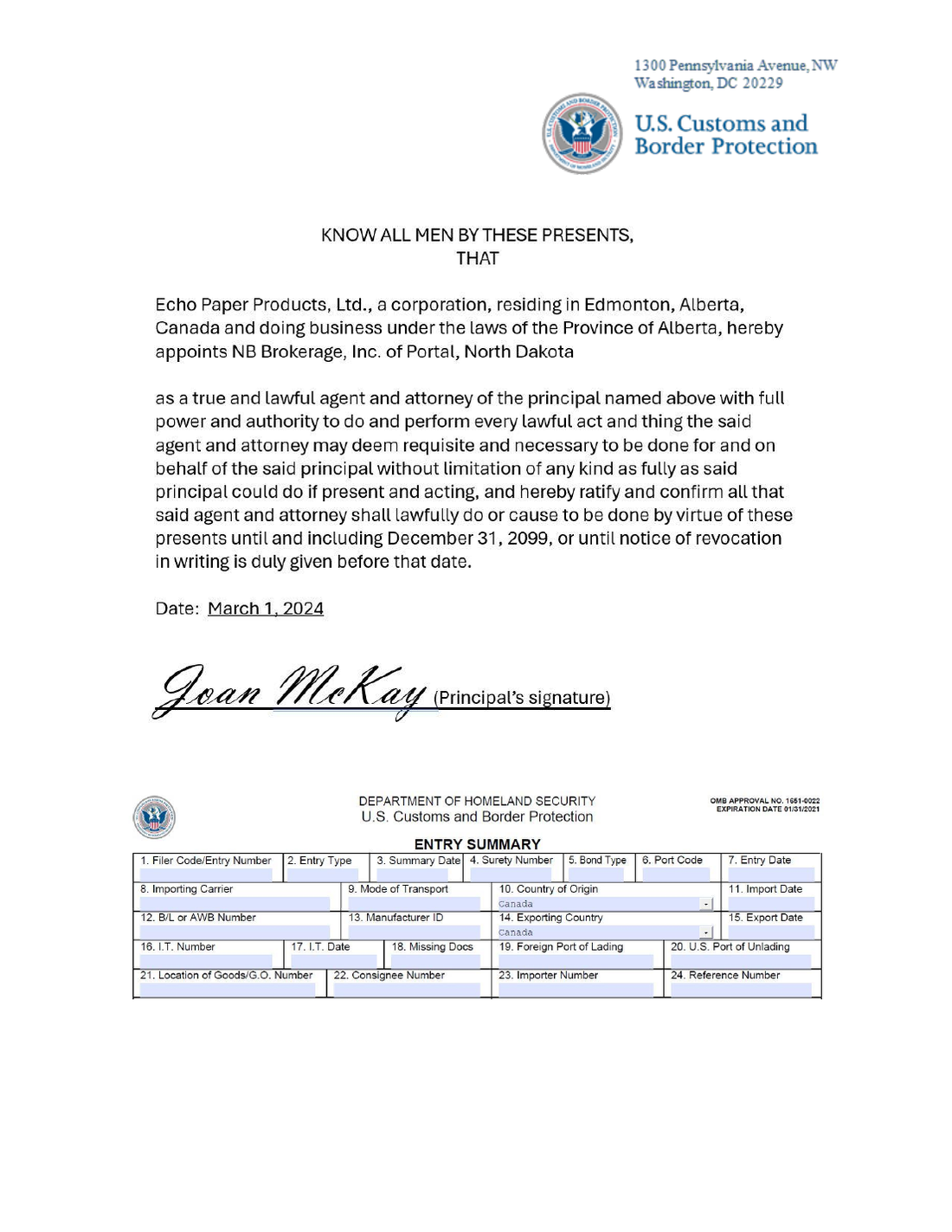
FACTS: Echo Paper Products Ltd. (Echo) of Edmonton, Alberta, Canada, has hired NB Brokerage, Inc. (NBB) of Portal, North Dakota, to file its import entries with U.S. CBP. Echo’s President is David Smith. Echo’s Vice President of Compliance is Joan McKay. Echo is a registered corporation in Alberta, Canada. Echo is not registered in any state in the United States. NBB provided a Power of Attorney for Echo to sign pursuant to 19 CFR 141.32. Joan McKay signed the POA on behalf of Echo. In Alberta, Echo manufactures uncoated paper products using Canadian origin paper pulp. Echo will be importing the uncoated paper into the United States for resale to vendors who provide self-print photographs equipment to be used by consumers. The Harmonized Tariff Schedule of the U.S. (HTSUS) classification for the uncoated paper Echo is importing is subheading 4802.56.6000, HTSUS. Echo produces and exports to the U.S. the same kind of uncoated paper products that, if imported from Australia and of Australian origin, are subject to anti-dumping (AD) duties under AD case number A-602-807. However, there is no AD case for uncoated paper products imported into the U.S. from Canada that are of Canadian origin. Echo has rented warehouse space from a North Dakota warehouse where Echo contractors repackage the paper into smaller quantities to ship to Echo’s U.S.-based clients. Echo advises NBB that it may need to re-export paper to meet demand in Canada. NBB determines it needs to make a USMCA post-summary claim on a type 01 consumption entry filed on behalf of Echo. Of the following methods for making post-summary claims, which ONE cannot be used to make a post-summary claim under the USMCA?
- File a post-summary claim under 19 USC 1520(d).
- File a post-summary correction (PSC). ✓
- File a reconciliation entry as long as the originally filed entry was flagged for FTA reconcilation.
- File a protest under 19 USC 1514 after the entry liquidates.
Why: A post-summary correction cannot be used to make a USMCA preference claim that was not made at entry; ACE BRPD Chapter 6 excludes post-importation preference claims from the PSC process because Congress created a dedicated remedy. The available routes are a post-importation claim under 19 U.S.C. 1520(d) as implemented by 19 CFR 182.31 ("the importer of that good may file a claim for a refund of any excess customs duties at any time within one year after the date of importation"), reconciliation where the entry was flagged, or a protest under 19 U.S.C. 1514 and 19 CFR 174.11 after liquidation. Option B is therefore the method that cannot be used.
A warehouse proprietor wishes to account for fungible merchandise using an alternative inventory method other than First-In-First-Out. Under 19 CFR 19.4, to whom must the application for approval be directed?
- The port director of the port nearest to where the warehouse is located
- The field director of regulatory audit for the region of the warehouse
- CBP Headquarters, Regulations and Rulings, Office of International Trade ✓
- The Director, Field Operations, having authority over that warehouse port
Why: Applications of this kind are routed by 19 CFR 19.4(b)(8)(iii) to CBP Headquarters, Regulations and Rulings, Office of International Trade, and to no field office. The provision is easy to lose in an open-book search because it is a two-sentence subparagraph tucked behind two much longer ones: 19 CFR 19.4(b)(8)(i) on direct identification and 19 CFR 19.4(b)(8)(ii) on FIFO. Both of those were re-read here, and neither involves any headquarters filing.
At which of the following ports of entry may an antique article otherwise prohibited entry by the Endangered Species Act of 1973 (16 USC 1521, et seq.) (Endangered Species Act) be entered? The merchandise meets all other U.S. Fish and Wildlife Service requirements.
- O'Hare International Airport, Chicago, Illinois ✓
- Service Port, Port Angeles, Washington
- Rochester International Airport, Rochester, Minnesota
- Area Port, Tampa, Florida
Why: 19 CFR 10.53(e)(4) allows an antique article otherwise prohibited entry by the Endangered Species Act to be entered only if it is entered at a port designated in 19 CFR 12.26, and the port list in 12.26(g)(2) names Boston, New York, Baltimore, Philadelphia, Miami, San Juan, New Orleans, Houston, Los Angeles, San Francisco, Anchorage, Honolulu, and O'Hare International Airport, Chicago, Illinois. Of the four choices only O'Hare appears on that list. Port Angeles, Rochester and Tampa are not designated ports for this purpose, so the article could not be entered for consumption there.
A company files a written application for accelerated payment of drawback with the drawback office where its claims will be filed. Under 19 CFR 190.92, within what period must CBP notify the applicant of its decision?
- In writing within 180 days of receipt of the application
- In writing within 30 days of receipt of the application
- In writing within 60 days of receipt of the application
- In writing within 90 days of receipt of the application ✓
Why: CBP's own deadline sits at 19 CFR 190.92(e)(2): written notice to the applicant within 90 days of receipt of the application, either of the decision to approve or deny it or of CBP's inability to approve, deny, or act on it and the reason for that. Section 190.92 is long and studded with competing periods, so this item is more a locating exercise than a comprehension one. The 30 days offered as a distractor appears twice elsewhere in the section, in paragraph (h) for appealing a denial or challenging a proposed revocation and in paragraph (f) for when an unchallenged proposed revocation takes effect.
What is the CLASSIFICATION of merchandise identified as "Polyhedral Bead Combo Pack?" The packaged beads contain 20 beads consisting of five shapes (cubes, pentagons, pyramids, hexagons, and dexagons) that are made of zinc alloy (zinc by weight is 98%). Each shape is approximately 3/8 inch on the diagonal. There is a hole drilled through the center of each shape. The shapes are strung on eight (8) inches of temporary wire made of steel. Except for the hole, the beads resemble polyhedral dice. The beads are in a plastic bag with a thin, printed cardboard topper which allows the package to be hung on a peg. The packaging states that the beads are intended to be used to make jewelry. Each package is invoiced at U.S. $1.99.
- 7117.19.9000
- 7901.20.0000
- 8308.90.3000 ✓
- 9504.90.6000
Why: Chapter 71, Note 9(a), defines "articles of jewelry" (and by extension the imitation jewelry of heading 7117) as small objects of personal adornment; unstrung base-metal beads intended as components for making jewelry are not themselves such articles. Beads and spangles of base metal are provided for eo nomine in heading 8308, so the zinc-alloy polyhedral beads are classified in 8308.90.3000. Subheading 7901.20 covers unwrought zinc alloys rather than finished beads, and 9504.90 covers games - the beads only resemble dice and are packaged and marketed for jewelry making.
You have received a “documents required” notification after the entry summary was filed. In reviewing the invoice, you handwrite additional information on the invoice to provide all required information, including the addition to the description of the bedspreads that the bedspread contains edging. Which ONE of the regulations listed below contains the requirement that prompted you to change the description as shown on the invoice provided?
- 19 CFR 141.86(a)(3)
- 19 CFR 141.86(h)(3)
- 19 CFR 141.89(a) ✓
- 19 CFR 142.6(a)(4)
Why: 19 CFR 141.89(a) prescribes additional invoice information for certain classes of merchandise, and for "Bed linen and Bedspreads" it requires a "[s]tatement as to whether or not the article contains any embroidery, lace, braid, edging, trimming, piping or applique work." Adding to the invoice that the bedspread contains edging is exactly that requirement, so 19 CFR 141.89(a) is the provision that prompted the change. 19 CFR 141.86 lists the *general* contents required of every invoice and 19 CFR 142.6 addresses the invoice required for entry - neither imposes this commodity-specific edging statement.
In which publication do the Presidential proclamations, Executive orders, and legislative enactments that establish quotas appear?
- The Tariff Schedule
- The Federal Register
- The Customs Bulletin ✓
- The Customs Regulations
Why: Publication of the instruments that create quotas is addressed in 19 CFR 132.2(a), which states that proclamations, Executive orders, and legislative enactments establishing tariff-rate and absolute quotas "are published in the Customs Bulletin." The Federal Register is the reflexive answer and the wrong one, even though it is where many other notices under parts 12 and 132 do appear. The distinction is worth fixing in mind, because paragraph (c) then demands strict compliance with the terms of those very documents.
A foreign producer's method of accounting already carries the apportioned value of a tooling assist inside its reported cost of materials, fabrication and other processing. The importer asks how the assist should be handled in building computed value.
- A separate amount is added and the cost of materials is left as is
- A separate amount is added and the packing costs are reduced to match
- No separate amount is added, because no component may be counted twice ✓
- The assist is excluded entirely from computed value in every instance
Why: Duplication is addressed head-on by 19 CFR 152.106(d), which observes that depending on the producer's method of accounting the value of assists may already be included in the producer's cost of materials, fabrication, and other processing, or in the general expenses, and states that where duplication occurs a separate amount for the value of the assists will not be added, because it is not intended that any component of computed value be included twice. The fourth option overshoots in the other direction: the same paragraph opens by confirming that computed value will include an amount equal to the apportioned value of any assists used in production, so assists are not categorically excluded - they are simply not counted a second time. Paragraph (d) also carries a limit worth remembering: engineering, development, artwork, design work, and plans and sketches undertaken in the United States are included only to the extent their value has been charged to the producer.
Quota-class merchandise is released under a special permit for immediate delivery before an entry summary for consumption is properly presented. What quota effect does that release have?
- It accords no quota priority, status or other benefit ✓
- It secures quota priority as of the date of release
- It secures quota status but not quota priority
- It accords quota benefits only if the quota is open
Why: Both paragraph (a)(2) and paragraph (a)(3) of 19 CFR 132.14 reach the same destination by different routes, providing that a release under a special permit for immediate delivery before proper presentation, and an inadvertent release, each "shall not accord merchandise any quota priority or status or entitle it to any other quota benefit." That phrase sweeps up all three concepts at once, so answers separating status from priority, or conditioning benefits on whether the quota is open, draw a distinction the regulation refuses to draw. Paragraph (b)(1) applies the identical principle to the issuance of a permit of delivery.
A broker submits an entry summary for consumption, without estimated duties attached, for preliminary review before the merchandise arrives within the limits of the port of entry. For quota purposes under 19 CFR 132.11a, what is the time of presentation?
- The time estimated duties are deposited after the carrier arrives ✓
- The time the merchandise is released from CBP custody by the port
- The time the entry summary is submitted for preliminary review
- The time the importing carrier arrives within the port limits
Why: Everything in 19 CFR 132.11a(b) depends on two facts being true together: the entry summary went in without estimated duties attached, and it went in before the merchandise arrived within the port limits. In that situation the time of presentation for quota purposes is the moment estimated duties are deposited after the importing carrier arrives within the port limits, so two events must both occur and it is the later of them that counts. Arrival of the carrier standing alone therefore fixes nothing, and the contrast with paragraph (a), where duties are already attached and delivery of the entry summary itself sets the time, is what the question is really testing.
CBP concludes an EAPA investigation and makes its determination as to evasion. What evidentiary standard governs that determination, and how soon must CBP send the parties a summary of it?
- Preponderance of evidence; a summary within five business days of it
- Clear and convincing evidence; a summary within ten business days
- Substantial evidence; a summary within five business days of it ✓
- Substantial evidence; a summary within thirty calendar days of it
Why: 19 CFR 165.27(a) supplies the standard and 19 CFR 165.27(b) supplies the deadline, and both paragraphs were re-read before this pairing was written. Paragraph (a) requires that upon conclusion of the investigation CBP make a determination based on substantial evidence as to whether covered merchandise was entered into the customs territory of the United States through evasion. Paragraph (b) then requires that no later than five business days after making that determination CBP send, via email or any other method approved or designated by CBP, a summary of the determination limited to publicly available information to the parties to the investigation. Both halves matter: 'substantial evidence' is the standard, and the summary is limited to publicly available information rather than being the full determination.
A specific manufacturing drawback ruling was approved in 2015, and no drawback claim has ever been filed under it. Under 19 CFR 190.8, what causes the ruling to cease to be in effect on that ground?
- The passage of 3 years without any claim, plus publication of notice of termination
- The passage of 5 years without any claim, occurring automatically without notice
- The passage of 5 years without any claim, plus publication of notice of termination ✓
- The passage of 10 years from approval, regardless of any claims filed under it
Why: Duration is governed by 19 CFR 190.8(h), which provides that a specific manufacturing drawback ruling remains in effect indefinitely unless one of two things happens, and paragraph (h)(1) requires two elements together: no drawback claim filed under the ruling for a period of 5 years AND publication of a notice of termination in the Customs Bulletin. Dormancy standing alone does not end the ruling. The only other terminating event, at 19 CFR 190.8(h)(2), which was re-read here, is a written request to terminate filed by the manufacturer or producer with CBP Headquarters.
Bales of tobacco contain both filler leaf and wrapper leaf, with wrapper making up 40 percent of the contents of each bale. Under 19 CFR 141.89, how must these bales be invoiced?
- As filler, since filler is the greater share
- As unclassified, pending CBP examination
- As mixed, since both leaf types are present
- As wrapper, since wrapper exceeds 35 percent ✓
Why: 19 CFR 141.89(a) provides, in its tobacco entry, that bales containing only filler leaf are invoiced as filler, bales containing filler and wrapper but not more than 35 percent wrapper are invoiced as mixed, and bales containing more than 35 percent wrapper are invoiced as wrapper. At 40 percent wrapper these bales cross that 35 percent threshold and must be invoiced as wrapper; “mixed” is wrong because it applies only at 35 percent wrapper or less, regardless of which leaf is the larger share.
A filer elects to present an entry summary for quota purposes without estimated duties attached by transmitting entry/entry summary information and a valid scheduled statement date through the Automated Broker Interface, but then fails to pay through the statement processing method. Under 19 CFR 132.11a, what consequence is authorized?
- The quota presentation time moves to the date of quota opening
- The Center director may require estimated duties on future filings ✓
- The Center director must cancel the entry and require a new entry
- The port director will assess liquidated damages under the bond
Why: Read 19 CFR 132.11a(c) for what it does not say. Its only stated consequence for electing the paragraph (a)(2) route and then failing to pay through the statement processing method is prospective: the Center director may require that future filings be made as an entry summary for consumption with estimated duties attached. Cancellation of the entry, a shift in the quota presentation time, and liquidated damages appear nowhere in the paragraph, so all three of those answers add machinery the text does not contain.
The following types of evidence of right to make entry for importations by common carrier when merchandise is not released directly to the carrier are acceptable types of evidence EXCEPT:
- A bill of lading or air waybill properly endorsed when required.
- An extract from a bill of lading or air waybill that has not been certified to be genuine by the carrier bringing the merchandise to the port of entry. ✓
- A certified duplicate bill of lading or air waybill with the carrier's certificate in the required form.
- A shipping receipt or other document presented in lieu of a bill of lading when entry is made by the actual consignee in person.
Why: 19 CFR 141.11(a)(2) accepts as evidence of the right to make entry 'an extract from a bill of lading or air waybill **certified to be genuine by the carrier** bringing the merchandise to the port of entry.' An uncertified extract therefore does not qualify. The other three options track 141.11(a)(1) (a properly endorsed bill of lading or air waybill presented by the holder), 141.11(a)(3) (a certified duplicate bearing the carrier's certificate in the prescribed form), and 141.11(a)(6) (a shipping receipt or other document where entry is made by the actual consignee in person).
Under 19 CFR 142.6(a), the commercial invoice furnished with the entry must contain all of the following EXCEPT:
- An adequate description of the merchandise
- The quantities of the merchandise imported
- The country of origin of the merchandise ✓
- The values or approximate values of the goods
Why: Five items are enumerated in 19 CFR 142.6(a)(1) through (a)(5): an adequate description of the merchandise, the quantities, the values or approximate values, the appropriate eight-digit subheading from the HTSUS, and the name and complete address of the foreign individual or firm responsible for invoicing the merchandise. Country of origin is not one of them. Paragraph (b) is what makes the omission survivable — other invoice information required by 19 CFR 141.86 through 141.89 may be left off the document filed with the entry documentation, provided it is included in the invoice or substitute document delivered when the entry summary documentation is filed.
Which of the following is expressly listed in 19 CFR 190.3 as a duty, tax, or fee on which drawback is allowable?
- Antidumping duties assessed on the imported merchandise
- Harbor maintenance taxes paid on the imported merchandise ✓
- Countervailing duties assessed on the imported merchandise
- State sales taxes collected on resale of the merchandise
Why: Scan the list in 19 CFR 190.3(a): ordinary customs duties, marking duties under 19 U.S.C. 1304(c), internal revenue taxes which attach upon importation, merchandise processing fees, and at 19 CFR 190.3(a)(5) harbor maintenance taxes, cross-referenced to section 24.24 of the chapter. Harbor maintenance taxes are thus drawback-eligible by express listing. The two duty options are excluded by name in paragraph (b), and state sales taxes on a domestic resale fail paragraph (a)'s threshold description entirely, since that paragraph reaches only duties, taxes and fees imposed under Federal law upon entry or importation.
ABC Importer is importing tracing paper from Germany which is classifiable under subheading 4806.30 of the HTSUS. The paper is being imported as rolls measuring 20 cm in width and 100 yards in length. Which of the following pieces of additional information is NOT required to be included for entry on the invoice or other document accompanying the invoice?
- Weight of paper in grams per square meter
- Length of the paper in cm ✓
- Diameter of the roll in cm
- Width of the paper in cm
Why: 19 CFR 141.89(a) sets additional invoice requirements for paper classifiable in Chapter 48, including weight in grams per square meter, thickness in micrometers, and, for paper imported in strips or rolls, the width in cm and the diameter of the rolls in cm. Length is required only for paper imported in rectangular sheets, where both length and width of the sheets must be given. Because this tracing paper is imported in rolls, the length of the paper is not required information, so option B is the answer.
Which ONE of the following four scenarios best demonstrates proper compliance with a record examination request? Assume that duly accredited representatives of the U.S. Department of Homeland Security (DHS) made each of the requests below.
- A customs broker receives a request to inspect records relating to a client that the broker stopped working with over five years ago. The broker has maintained the requested records but informs DHS that they will not make the records available for inspection because the period of retention has ended.
- A customs broker receives a request to inspect records relating to a particular entry of merchandise from an entry made two years ago. The broker mails the original paper version of the requested records to DHS, postmarked 60 calendar days after the request was made.
- A customs broker receives reasonable notice of a site visit. The notice includes a request to inspect records pertaining to a client of the brokerage. During the site visit, the broker informs DHS that the records are kept off-site and will not be available for inspection during the visit. The broker states that they will send the records electronically within 30 calendar days of the visit.
- A customs broker receives a request to inspect a customs broker’s records relating to an unused merchandise drawback claim. The request specifies that the broker has up to 120 calendar days to provide the requested records. On the 45th calendar day from the request, the broker sends the original electronic version of the requested records to DHS. ✓
Why: 19 CFR 111.25(b) requires the broker's designated recordkeeping contact to make all records available to DHS "within thirty (30) calendar days, or such longer time as specified by DHS." In option D the request itself specified 120 days and the broker produced on day 45, so the response is timely. Option B exceeds the 30-day default with no longer period specified; option C fails 111.25(a), which requires records be maintained so they "may readily be examined" and be made available upon reasonable notice; and option A ignores both the five-year retention period in 111.23(b)/163.4(a) and 111.25(a)'s requirement that records be produced during any longer period in which they remain in the broker's possession.
An allegation by an interested party that an importer of covered merchandise has evaded antidumping or countervailing (AD/CVD) duty order under the Enforce and Protect Act of 2015 (EAPA) must include all of the following information EXCEPT:
- Description of the covered merchandise
- Applicable AD/CVD orders
- Name and address of importer against whom the allegation is brought
- An explanation of the relationship between the importer and the interested party ✓
Why: 19 CFR 165.11(b) lists what an EAPA allegation must contain: the name of the interested party and any filing agent with an email address, an explanation of how the party qualifies as an interested party under 19 CFR 165.1, the name and address of the importer against whom the allegation is brought, a description of the covered merchandise, the applicable AD/CVD orders, and the information reasonably available to support the allegation. What paragraph (b)(2) requires is an explanation of the alleging party's own interested-party status, not an explanation of any relationship between that party and the importer, so option D is the item not required. The description of the merchandise, the applicable orders, and the importer's name and address correspond to (b)(4), (b)(5) and (b)(3).
Which statement is FALSE with respect to the applicable rates of duty?
- Subject to exceptions specified in the Customs Regulations, rates of duty applicable to merchandise shall be the rates in effect at the "time of entry," which is defined in 19 CFR 141.68.
- Merchandise entered for warehouse is dutiable at the rates in effect at the time withdrawal for consumption is made in accordance with 19 CFR 141.68(g).
- Dutiable merchandise eligible for informal mail entry is dutiable at the rates in effect at the time the preparation of the entry documentation by a CBP employee is completed.
- For quota-class merchandise where the quota period opens in one calendar year and closes in another calendar year, the applicable rate of duty shall be determined at the time of liquidation. ✓
Why: 19 CFR 141.68 fixes the "time of entry" that determines the applicable rates of duty, and its subsections cover the situations in options A-C: 141.68(g) sets the time of entry for warehouse withdrawals for consumption, and 141.68(f) sets it for informal mail entries at the time a CBP employee completes preparing the entry documentation. For quota-class merchandise the rate turns on presentation of the entry summary or withdrawal for consumption in proper form (19 CFR 132.11a; 132.1(d)), not on liquidation. Option D is therefore the FALSE statement. ⚠ Law changed after this sitting: 19 CFR 145.12(b)(2) was rewritten by CBP Dec. 26-13, "Indefinite Suspension of the De Minimis Exemption for Mail Shipments and New Postal Informal Entry Process" [91 FR 37801, June 24, 2026], effective July 24, 2026. Under current 145.12(b)(2) a mail informal entry is dutiable at the rates in effect when preparation of the entry is completed, and preparation is completed when the entry is properly transmitted to CBP by the filer; the requirement that a CBP employee prepare the entry was removed. CBP's keyed answer above (option D) is correct for the May 2024 examination and is reproduced unaltered. Students should note that option C, a true statement as at the sitting, now conflicts with current 19 CFR 145.12(b)(2). 19 CFR 141.68(f) was not amended by that rule and still fixes the time of entry for an informal mail entry at completion by a CBP employee, so the two provisions currently read inconsistently.
How long does an importer have to file an application with the Port Director for abatement or refund of duties resulting from the destruction of merchandise in an accidental fire while located in a Customs Bonded Warehouse?
- Within thirty (30) days of the importer's discovery of the destruction ✓
- Within thirty (30) days of date of entry into the warehouse
- Within ninety (90) days of the date of the warehouse proprietor's discovery
- Within ninety (90) days of the date of the notification by the warehouse proprietor to the importer.
Why: 19 CFR 158.23 requires the importer to file the application on CBP Form 4315, or its electronic equivalent, in duplicate **within 30 days from the date of his discovery** of the loss, theft, injury, or destruction, and then to file any evidence required by 158.26 or 158.27 within 90 days of that discovery. The trigger is the importer's own discovery, not the date of warehouse entry, the proprietor's discovery, or the date the proprietor notified the importer, and the 90-day figure relates to the supporting evidence rather than the application itself.
Upon conclusion of an investigation under 19 CFR 165.15, CBP will make a determination based on _____ as to whether covered merchandise was entered into the customs territory of the United States through evasion.
- probable cause
- clear and convincing evidence
- preponderance of evidence
- substantial evidence ✓
Why: 19 CFR 165.27(a) provides that "upon conclusion of the investigation, CBP will make a determination based on substantial evidence as to whether covered merchandise was entered into the customs territory of the United States through evasion." Substantial evidence is the governing standard for an EAPA determination - not probable cause, preponderance of the evidence, or clear and convincing evidence.
A consignee asks the port director to take possession of imported merchandise. Under what timing condition does that request result in general order treatment?
- Immediately, since the request is made by the consignee
- After 1 day from entry of the vessel or vehicle report ✓
- After 5 days from entry of the vessel or vehicle report
- After 15 days from entry of the vessel or vehicle report
Why: The request alone is not enough, because timing is built into 19 CFR 127.1(e), which reaches merchandise taken into possession by the port director "after the expiration of 1 day after entry of the vessel or report of the vehicle." The request may come from the consignee, the owner, the master of the vessel, or the person in charge of the vehicle, so the identity of the requester neither shortens nor lengthens the period. Compare § 123.10(g), which likewise sends goods taken under 19 U.S.C. 1490(b) to a general order warehouse "after 1 day after the day the vehicle arrived"; the two provisions agree, and neither supports a longer wait.
A broker that is a corporation has had no officer holding a valid individual broker's license for a continuous period of 130 days. Under 19 CFR 111.45, what is the consequence?
- Assessment of a monetary penalty on the officers
- Revocation by law of the license and its permit ✓
- Revocation by law of the national permit only
- Suspension of the license for a specified time
Why: 19 CFR 111.45(a) provides that a corporate broker's failure, during any continuous period of 120 days, to have at least one officer holding a valid individual broker's license results in revocation by operation of law of both the license and the national permit issued to the corporation. The “national permit only” answer describes the separate 180-day rule in the same paragraph for failure to employ a national permit qualifier; at 130 days the 120-day license trigger has already been passed.
After the merchandise has arrived, merchandise for which entry is required will be entered within ____ calendar days after landing from a vessel, aircraft or vehicle, or after arrival at the port of destination in the case of merchandise transported in bond.
- 15 ✓
- 30
- 60
- 90
Why: 19 CFR 142.2(a) provides that "merchandise for which entry is required will be entered within 15 calendar days after landing from a vessel, aircraft or vehicle, or after arrival at the port of destination in the case of merchandise transported in bond." Fifteen calendar days is the deadline; merchandise not entered within that period is subject to general order under 19 U.S.C. 1490.
A U.S. buyer purchased merchandise from an unrelated manufacturer in India. The terms of the sale were ex-factory packed. The U.S. buyer paid the foreign manufacturer $18,344 which included a $1,500 packing fee. The U.S. buyer also paid $4,500 to a freight forwarder to cover expenses for inland freight of $500 and air freight of $4,000. In addition, the U.S. buyer paid a commission of $1,500 to a buying agent who facilitated the purchase of the merchandise. What is the entered value for the imported merchandise?
- $18,344.00 ✓
- $12,344.00
- $6,500.00
- $25,844.00
Why: The entered value is the price actually paid or payable, $18,344.00, which already includes the $1,500 packing charge - packing costs are dutiable under 19 CFR 152.103(b)(1)(i) and, being inside the price, require no separate addition. The sale was ex-factory packed, so under 19 CFR 152.103(a)(5)(i) the foreign inland freight and other charges incident to international shipment "will not be added to the price," and the $4,000 air freight is excluded from the price actually paid or payable by 19 CFR 152.102(f) in any event. The $1,500 buying agent commission is not a selling commission and is not among the additions listed in 152.103(b)(1), so it too is not dutiable - leaving $18,344.00.
An antique claimed free of duty under subheading 9706.00.00, HTSUS, has been repaired with a substantial amount of additional material, but the repair did not change the original form or shape. Under 19 CFR 10.53, how is duty assessed?
- Duty is assessed on the full appraised value of the article
- Duty is assessed on the added portion of the repaired article ✓
- The entire article is excluded from free entry as an antique
- The entire article is admitted free of duty despite repairs
Why: Repairs split into two outcomes in 19 CFR 10.53(b), and these facts, substantial additional material with the original form or shape unchanged, take the first: the original and added portions are appraised and reported as separate entities, with the basis plainly indicated on the invoice, and duty is assessed on the portion added. Total exclusion from free entry under subheading 9706.00.00 is the other outcome, reserved for a repair adding a feature which changes the article substantially from the article originally produced, or where the antique portion has otherwise lost its identity. The paragraph's opening premise is worth holding on to as well, since antiques of the prescribed age are admitted free of duty though repaired or renovated, so repair by itself costs nothing.
A broker's report to CBP under 19 CFR 111.32 concerning separation from a client must include all of the following EXCEPT:
- The name of the client concerned
- The date of the separation or cancellation
- The reason for the separation or cancellation
- The entry numbers filed for that client ✓
Why: 19 CFR 111.32 specifies exactly three contents for the report: the client name, the date of separation or cancellation, and the reason for the separation or cancellation. Entry numbers are not among them. Because the section states its list in closed terms rather than with an including-but-not-limited-to formula, a fourth item cannot be read in. The rest of the section is prohibitory and worth reading alongside the reporting duty: a broker must not file or procure or assist in the filing of any claim, document, affidavit, or other paper known by the broker to be false, and must not give or solicit or procure the giving of information or testimony the broker knew or should have known was false or misleading in any matter pending before DHS.
Disregarding antidumping and/or countervailing duties, if any, what is the duty rate of an imported aluminum product valued at $39,999.00 with a country of origin of the Russian Federation classified under subheading 7606.12.3035?
- 3%
- 13.5%
- 70% ✓
- 83.5%
Why: General Note 3(b) provides that goods of countries enumerated there are dutiable at the Column 2 rates rather than the Column 1 "General" rates, and normal trade relations treatment for the Russian Federation has been suspended, so Column 1 treatment is unavailable for this aluminum. Applying the rate that governs 7606.12.3035 for Russian-origin merchandise, read together with heading 9903.90.09 and Chapter 99, Subchapter III, U.S. Note 30, yields 70%. The 3% choice is simply the Column 1 general rate that no longer applies to goods of Russia, and 83.5% stacks an additional rate that Note 30 does not impose on this article.
A broker's employee has a personal contact at a federal agency who offers to look up restricted internal data that would help resolve a client's classification dispute. The employee would not access any system directly. Under 19 CFR 111.33, may the broker accept the offer?
- No; procuring such information indirectly is equally prohibited ✓
- Yes; if the information is used only for a lawful customs purpose
- No, but the prohibition reaches only classified Government data
- Yes; provided the other agency raises no objection to sharing
Why: The two phrases that decide this are both in the single sentence at 19 CFR 111.33. A broker must not procure or attempt to procure, directly or indirectly, information from Government records or other Government sources of any kind to which access is not granted by proper authority. Directly or indirectly disposes of the argument that using an intermediary changes anything, and of any kind disposes of the argument that only classified material is covered, since the reach extends to Government sources generally rather than to a defined category of sensitive records. The section is also indifferent to motive: a lawful customs purpose is not an exception, and the only thing that legitimises access is a grant by proper authority.
19 CFR 190.10(b) lists the information that records supporting a transfer of drawback eligible merchandise must include. Which of the following is NOT among the items expressly listed there?
- Date of physical delivery
- Date of importation
- Date of exportation ✓
- Port where import entry filed
Why: A date of exportation appears nowhere in 19 CFR 190.10(b), whose eleven enumerated items address the delivery side and the import side of the transaction only. The three distractors were each located in the text before this explanation was written: date of physical delivery at 19 CFR 190.10(b)(2), date of importation at 19 CFR 190.10(b)(6), and port where import entry filed at 19 CFR 190.10(b)(7). Export data of that kind is demanded instead by 19 CFR 190.72(a) as proof of exportation, a separate requirement resting on a separate party.
Of the four choices below, which is the best CLASSIFICATION of alloy steel coils? The cold-rolled steel is successively superimposed in coils and measures 1220 mm in width and 3.75 mm in thickness. The steel chemistry consists of 0.15% Carbon, 0.7 % Titanium, and 25% Nickel. The coils have not been further worked than cold-rolled.
- 7209.15.0000
- 7219.32.0035
- 7225.50.8010 ✓
- 7226.99.0130
Why: Chapter 72 Note 1(f) defines "other alloy steel," and at 25 percent nickel and 0.7 percent titanium this steel is squarely alloy steel; with no chromium it is not stainless steel, which eliminates heading 7219, and it is not non-alloy, which eliminates heading 7209. Note 1(k) defines flat-rolled products, and because the coils are 1,220 mm wide - 600 mm or more - GRI 1 places them in heading 7225 (flat-rolled products of other alloy steel of a width of 600 mm or more) rather than heading 7226, which covers widths of less than 600 mm. Since the coils are not further worked than cold-rolled, the correct provision is 7225.50, with the statistical breakout at 7225.50.8010.
An entry liquidates on September 10 with a refund of excessive duties due to the importer of record. Under 19 CFR 24.36, by when must the refund, including any interest, be paid, and what follows if it is not?
- Within 30 days of liquidation; the refund is delinquent and accrues interest ✓
- Within 30 days of liquidation; the refund is delinquent but accrues no interest
- Within 60 days of liquidation; the refund is delinquent and accrues interest
- Within 90 days of liquidation; the refund is delinquent but accrues no interest
Why: Payment timing comes from 19 CFR 24.36(a)(2), which requires a refund determined to be due upon liquidation or reliquidation, including a refund consisting only of accrued interest, to be paid within 30 days of the date of liquidation or reliquidation. 19 CFR 24.36(a)(3) then makes an unpaid refund delinquent thereafter, with interest under 19 U.S.C. 1505(d) accruing on the unpaid balance by 30-day periods until the full balance is paid. That same paragraph carries two carve-outs an open-book reader should note: no interest accrues during the 30-day period in which the refund is paid, and none accrues where CBP timely certified an electronic refund but could not deliver it solely because the recipient failed to supply banking information.
Which article meets the definition of a "piratical article" for purposes of 19 CFR part 133?
- A lawfully made copy imported without the owner's consent
- An article bearing a counterfeit registered trademark
- A device designed to circumvent a copyright protection
- An unlawfully made copy of a recorded copyrighted work ✓
Why: Narrowness is the point of 19 CFR 133.42(a), which confines the term to "an unlawfully made (without the authorization of the copyright owner) copy or phonorecord of a recorded copyrighted work, importation of which is prohibited by the Copyright Act of 1976, as amended." Two elements do the excluding: the copy must be unlawfully made, so a lawfully made copy sits outside the definition however it was imported, and the subject must be a copyrighted work rather than a trademark, which is § 133.21's territory. The circumvention device belongs to the DMCA definition at § 133.47(a)(2), so three neighbouring sections carry three different definitions.
Which of the following scenarios demonstrates that a customs broker may have failed to maintain responsible supervision and control over their customs business?
- John Smith Customs Brokerage (Smith) terminated Sally Johnson's (Johnson) employment. Johnson was listed in Smith's Automated Commercial Environment (ACE) portal account as the knowledgeable point of contact to be available to CBP during and outside of normal operating hours. Smith updated Johnson's employee record but did not designate a new knowledgeable point of contact in ACE. CBP has been unable to contact Smith for over six months. ✓
- Countrywide Customs Brokerage (Countrywide) has ten offices across the United States under a National Permit with an approved supervision plan. Two of these offices do not have a licensed broker on site and have not had one for six months. Although Countrywide has not requested a waiver, Countrywide has a licensed broker conduct a supervisory visit twice a week to those offices.
- National Customs Brokerage (National) unwittingly hired James Jones, Sr., a convicted felon who committed embezzlement ten (10) years ago. On his employment application, Jones stated that he did not have any felony convictions and used another person's social security number. National did not seek a waiver to employ a convicted felon.
- Trustworthy Customs Broker Co. (Trustworthy) received $10,000.00 from Sally Doe, an importer of handblown glass figurines. Sally has designated Trustworthy to make payment for all imports over the course of a year, and to collect any refunds issued by CBP. Sally owes $4,000.00 in estimated duties for her most recent acquisition of figurines. Trustworthy remitted payment to CBP within 12 days of the figurines’ arrival at the Port of Long Beach.
Why: 19 CFR 111.3(b) requires a broker operating under a national permit to designate a knowledgeable point of contact available to CBP during and outside normal operating hours and to keep that contact information accurate and current in a CBP-authorized EDI system; 19 CFR 111.28(a)(12) lists communications between CBP and the broker and the broker's responsiveness to CBP as a responsible-supervision factor. Smith removed the terminated employee's record but never designated a replacement contact and CBP has been unable to reach the firm for six months, which is a direct failure on both counts. The other scenarios do not show a lapse: frequent supervisory visits by a licensed broker are an express 111.28(a)(7) factor weighing in the broker's favour, the felony hire was concealed by the applicant so it was not 'knowing' employment, and remitting a client's duties within 12 days of arrival is timely payment under 111.29(a).
What is the CLASSIFICATION of a cat harness, developed by the Princess Paws Pet Company. The harnesses are designed for cats and are available in size small, medium, and large. They are constructed of genuine leather and are partially covered with a plastic reflective material for safety.
- 4112.00.3060
- 4201.00.3000
- 4201.00.6000 ✓
- 4205.00.8000
Why: Under GRI 1 heading 4201 covers “saddlery and harness for any animal ... of any material,” which names a cat harness eo nomine, so the heading texts themselves exclude heading 4112 (leather, not an article of leather) and the residual heading 4205 (other articles of leather), and GRI 3 is never reached. Heading 4201 has no material-based breakout: the only U.S. subdivisions are 4201.00.3000, “Dog leashes, collars, muzzles, harnesses and similar dog equipment,” and 4201.00.6000, “Other.” Because this article is a cat harness rather than dog equipment, 4201.00.3000 does not apply, leaving 4201.00.6000.
Under 19 CFR 165.24, CBP must issue notice of a reasonable suspicion decision to the parties to the investigation within:
- ten business days after taking interim measures
- five business days after initiating investigation
- ten business days after initiating investigation
- five business days after taking interim measures ✓
Why: 19 CFR 165.24(c) requires CBP to issue notice of a reasonable suspicion decision to the parties to the investigation within five business days after taking interim measures. The ten-business-day answer confuses this with the second sentence of the same paragraph, which gives CBP 10 business days from issuance of the notice of initiation to provide the parties a public version of the administrative record.
A summons is served on a company officer at the company's headquarters, compelling his appearance before a Customs officer. What limit applies to the place of appearance stated in the summons?
- It must be within 50 miles of the place where the summons was served
- It must be within 100 miles of the place where the summons was served ✓
- It must be within 250 miles of the place where the summons was served
- It must be within 500 miles of the place where the summons was served
Why: Distance is capped by 19 CFR 163.7(b)(1)(ii), which requires the summons to state the address within the customs territory of the United States where the person shall appear, not to exceed 100 miles from the place where the summons was served. The benchmark is the place of service, not the person's residence or the issuing office - a distinction the subparagraph draws explicitly. Three other items must also appear under 19 CFR 163.7(b)(1): the name, title, and telephone number of the Customs officer before whom the appearance shall take place; the time of appearance; and the name, address, and telephone number of the Customs officer issuing the summons. Where records are also demanded, 19 CFR 163.7(b)(2) requires all of that information plus a description of the records with reasonable specificity.
A corporate broker submits an application for a national permit in October and remits three-twelfths of the annual permit user fee, reasoning that only part of the calendar year remains. Under 19 CFR 111.96, is that remittance correct?
- Yes; the fee is prorated from the month in which the permit is granted
- Yes; provided the balance is paid by the published due date
- No; the permit user fee is not due until the following January
- No; the full permit user fee must be remitted with the application ✓
Why: 19 CFR 111.96(c) allows no proration. It states that when a broker submits an application for a national permit under 19 CFR 111.19(b), the full permit user fee must be remitted with the application, regardless of the point during the calendar year at which the application is submitted. That last clause exists precisely to defeat the arithmetic in this scenario. The paragraph also carries the harshest consequence in the section, and it operates without any discretionary step: if a broker fails to pay the annual permit user fee by the published due date, the permit is revoked by operation of law. The processing Center's written notification of the failure and the revocation follows the revocation rather than causing it.
An article whose country of origin is Canada under the part 102 Rules is imported into the United States and is distributed as a gift by the company that bought it, so the person who receives the article never pays for it. Who is the ultimate purchaser under Part 134?
- The Canadian producer is ultimate purchaser
- The purchaser of the gift is ultimate purchaser ✓
- The recipient of the gift is ultimate purchaser
- The importing retailer is ultimate purchaser
Why: 19 CFR 134.1(d)(4) makes the recipient the ultimate purchaser when an imported article is distributed as a gift, unless the good is a good of a NAFTA or USMCA country, in which case the purchaser of the gift is the ultimate purchaser. Because 19 CFR 134.1(g) makes an article with Canada as its country of origin under the part 102 Rules a good of a USMCA country, the purchaser controls here. The recipient option is the tempting distractor because it states the general rule without the USMCA carve-out.
For purposes of the valuation subpart, each of the following is an unacceptable basis of appraisement EXCEPT:
- The selling price in the United States of merchandise produced in the United States
- The price of merchandise in the domestic market of the country of exportation
- A cost of production determined under 19 CFR 152.106 for similar merchandise ✓
- A system providing for appraisement at the higher of two alternative values
Why: The exception is buried inside 19 CFR 152.108(d), which bars 'a cost of production, other than a value determined under 152.106 for merchandise that is identical merchandise, or similar merchandise, to the merchandise being appraised.' That 'other than' clause is the whole question: a cost-of-production figure is prohibited generally, but a computed value arrived at under 19 CFR 152.106 for identical or similar merchandise is carved out and remains available. Reading (d) too quickly and treating it as a flat ban on cost of production is the standard error. The three prohibited options track the section verbatim - the United States selling price of domestically produced merchandise is barred by 19 CFR 152.108(a), the exporting country's domestic market price by 19 CFR 152.108(c), and the higher-of-two-values system by 19 CFR 152.108(b); each of those three paragraphs was re-read to confirm the pairing.
A customs broker license applicant has been denied a customs broker license. Which of the following best describes the next action the applicant must take to initiate an appeal?
- File with the Executive Assistant Commissioner, Office of Trade, in writing, a request for additional review that the Executive Assistant Commissioner deems appropriate not later than ninety (90) days of the denial.
- File with the appropriate Executive Director, Office of Trade, in writing, additional information or arguments in support of the application. Such information and arguments must be received by the Executive Director within sixty (60) calendar days of the denial. ✓
- Appeal the decision to the Court of International Trade within thirty (30) days of the denial.
- Appeal the decision by filing a written or electronic appeal with the Office of Trade, CBP Headquarters within thirty (30) days of the denial.
Why: 19 CFR 111.17(a) is the first step in the license-denial appeal ladder: the applicant files with the appropriate Executive Director, Office of Trade, in writing, additional information or arguments in support of the application, and that filing must be received within 60 calendar days of the denial. Review by the Executive Assistant Commissioner under 111.17(b) and appeal to the Court of International Trade under 111.17(c) come only after that first-level review is decided, so those options describe later stages, and both the 90-day and 30-day periods offered are wrong - every stage of 111.17 runs on 60 calendar days.
CBP issues a bill for vessel repair duties. Under 19 CFR 24.3a, how is the late payment date appearing on that bill determined?
- It is the date 15 calendar days after the interest computation date
- It is the date 30 calendar days after the interest computation date ✓
- It is the date 30 calendar days after liquidation of the vessel entry
- It is the date 60 calendar days after the date the bill is received
Why: Bills for vessel repair duties, reimbursable services, and miscellaneous amounts are handled by 19 CFR 24.3a(b)(1), which provides that the late payment date is the date 30 calendar days after the interest computation date, and that the interest computation date is initially the bill date. The competing 15-day figure comes from 19 CFR 24.3a(b)(3), re-read here, and applies only where a depository bank notifies CBP by debit voucher of a dishonored payment. Matching the interval to the type of bill, rather than reciting a single number, is what the item tests.
What is the CLASSIFICATION of heat insulating solid building bricks made of ceramic?
- 2515.11.0000
- 6802.29.9000
- 6904.10.0010 ✓
- 6907.30.1051
Why: Heading 6904 provides eo nomine for ceramic building bricks, flooring blocks, support or filler tiles and the like, and 6904.10.0010 is the breakout for solid building bricks, which is exactly what the merchandise is. Heading 2515 covers marble and other calcareous monumental or building stone, and 6802 covers worked monumental or building stone - neither reaches a ceramic article. Heading 6907 covers ceramic flags and paving, hearth or wall tiles, not bricks.
A broker fails to file the triennial status report by March 1 of the reporting year which results in the suspension of their license by operation of law. In addition to filing the triennial status report, what must the broker do to reinstate their license?
- Pay a fine of $500 within 90 calendar days from the date the original report was due.
- File a protest with CBP within 180 days showing just cause as to why their license should be reinstated.
- File an appeal with CBP within three months of the date of the notice of suspension.
- Pay the required fee within 60 calendar days of the date of the notice of suspension. ✓
Why: 19 CFR 111.30(d)(4) provides that a broker who fails to file the triennial status report by March 1 of the reporting year has the licence suspended by operation of law on that date, with CBP transmitting written notice of suspension by March 31. The licence is reinstated only if the broker files the required report **and pays the required fee within 60 calendar days of the date of the notice of suspension**; missing that window revokes the licence by operation of law. There is no $500 fine, no protest, and no three-month appeal route - those options describe procedures that do not exist under this provision.
An entire shipment is found not to agree with the invoice, and there is no evidence of any intent to defraud. Under 19 CFR 152.3, what happens to the entry?
- The original entry is amended and the duties adjusted later
- A new entry is required and the original duty is refunded ✓
- The shipment is seized pending a forfeiture determination
- The shipment is appraised on the invoice values as filed
Why: Where the entire shipment fails to agree with the invoice and there is no evidence of intent to defraud, 19 CFR 152.3 calls for a new entry and refunds the estimated duty paid on the original entry on liquidation, as in the case of a nonimportation. That is a different remedy from the one the same paragraph applies to a partial discrepancy, where duties are simply assessed on the merchandise actually found, so match the sentence to the scope of the mismatch before answering. Seizure is expressly off the table where the discrepancy is a mistake rather than fraud, since the section directs that no proceedings for forfeiture be taken.