Practical Exercise: practice questions
About this subject area
In recent CBLE sittings this subject area has made up roughly 4–10% of the 80 scored questions, so our full practice exam gives it 6 of the 80.
The full bank holds 61 questions for this subject area, each with an explanation citing the provision that decides it. Below are 6 free questions with answers.
Key sources
The provisions the questions in this subject area cite most often.
- 19 CFR 141.86
- 19 CFR 18.8
- 19 CFR 141.101
- 19 CFR 24.5
- 19 CFR 18.6
- 19 CFR 24.25
Free Practical Exercise questions

FACTS: Baltimore Quick Printers of Baltimore, Maryland (BQ Printers) ordered a Luxemburg Digital Press (press) from manufacturer Stampa Fabbrica of Genoa, Italy (Stampa), an unrelated party. The contract price for the machine is $60,000.00. Stampa will prepay international freight and insurance and invoice the BQ Printers on an C.I.F. (cost, insurance, freight) basis. Although the press was on backorder at the time it was ordered, Stampa promised the next available press would be shipped to the BQ Printers. Stampa shipped a press to a purchaser in Beijing, China, but the purchaser declined to accept the shipment claiming that it was late. Stampa contacted BQ Printers to confirm their order and offered BQ Printers a rebate to induce acceptance of the press that was rejected by the purchaser in China. BQ Printers confirmed the order and Stampa arranged for an air shipment from China to Baltimore, Maryland. While enroute from Beijing, China to Baltimore, Maryland, the flight was diverted from Baltimore, Maryland to Boston, Massachusetts due to inclement weather in Baltimore. BQ Printers's Customs broker, Fast Broker, LLC (Fast) was notified of the flight diversion. An alert employee of Fast modified the unsubmitted entry / entry summary documentation in their automated broker interface system to reflect that the shipment was landing and being unladed in Boston instead of Baltimore, the intended port of entry. The employee worked with a representative of Shark Airlines to arrange for ground transportation from Boston to Baltimore by Exact Trucking, a carrier bonded under 19 CFR 113.63 for the transportation and delivery of merchandise. Fast created the Customs Form 7512 (CF 7512) naming Exact Trucking as the bonded carrier. Below are the documents timely provided by Shark Airlines to Fast prior to exportation. Using the provided partial manifest, airway bill of lading, commercial invoice, and broker bill to the importer, as well as the facts above, answer the following five (5) questions choosing the best answer. On the provided Broker Invoice, MPF stands for merchandise processing fee, and HMF stands for Harbor Maintenance Fee. The date of importation is January 17, 2024. BQ Printers paid Stampa’s invoice on January 19, 2024. Stampa issued the rebate on January 29, 2024. Use these additional facts to answer this question. Fast Broker, LLC (Fast) obtained additional documentation from the client stating that the country of origin of the Luxemburg Digital Press is Italy. Baltimore Quick Printers (BQ Printers) has already paid the broker's invoice. How much did Fast overcharge BQ Printers on the Broker Invoice?
- $75.00
- $207.84
- $4,575.00 ✓
- $4,782.84
Why: Two of the charges on the broker's invoice fall away once the press is shown to originate in Italy rather than China: the Section 301 duty billed under HTS 9903.88.15 (7.5 percent of the $60,000 entered value, $4,500) applies only to products of China, and the Harbor Maintenance Fee under 19 CFR 24.24(a) ($75.00) applies only to commercial cargo loaded or unloaded from a commercial **vessel** - this press moved by air. Together that is a $4,575.00 overcharge. The merchandise processing fee of $207.84 under 19 CFR 24.23 remains properly due regardless of origin, so the $4,782.84 figure over-refunds by including it.
A good imported into the United States would have qualified as an originating good, but no claim for preferential tariff treatment was made at the time of importation. Under 19 CFR 182.31, when may the importer file a claim for refund of excess customs duties?
- Within one year after the date of importation of the good ✓
- Within one year after the date of liquidation of the entry
- Within 90 days after the date of entry summary filing
- Within 180 days after the date of importation of the good
Why: 19 CFR 182.31 starts its clock at importation and nowhere else: an importer whose good would have qualified as originating, but for which no claim for preferential tariff treatment was made, may file a claim for refund of any excess customs duties at any time within one year after the date of importation of the good, in accordance with 19 U.S.C. 1520(d). Liquidation is the stage at which the refund is granted, which is what makes the liquidation-date option tempting, but the section keeps filing and refund distinct. Its opening words, 'Notwithstanding any other available remedy,' confirm that this route runs alongside rather than in place of the ordinary avenues.
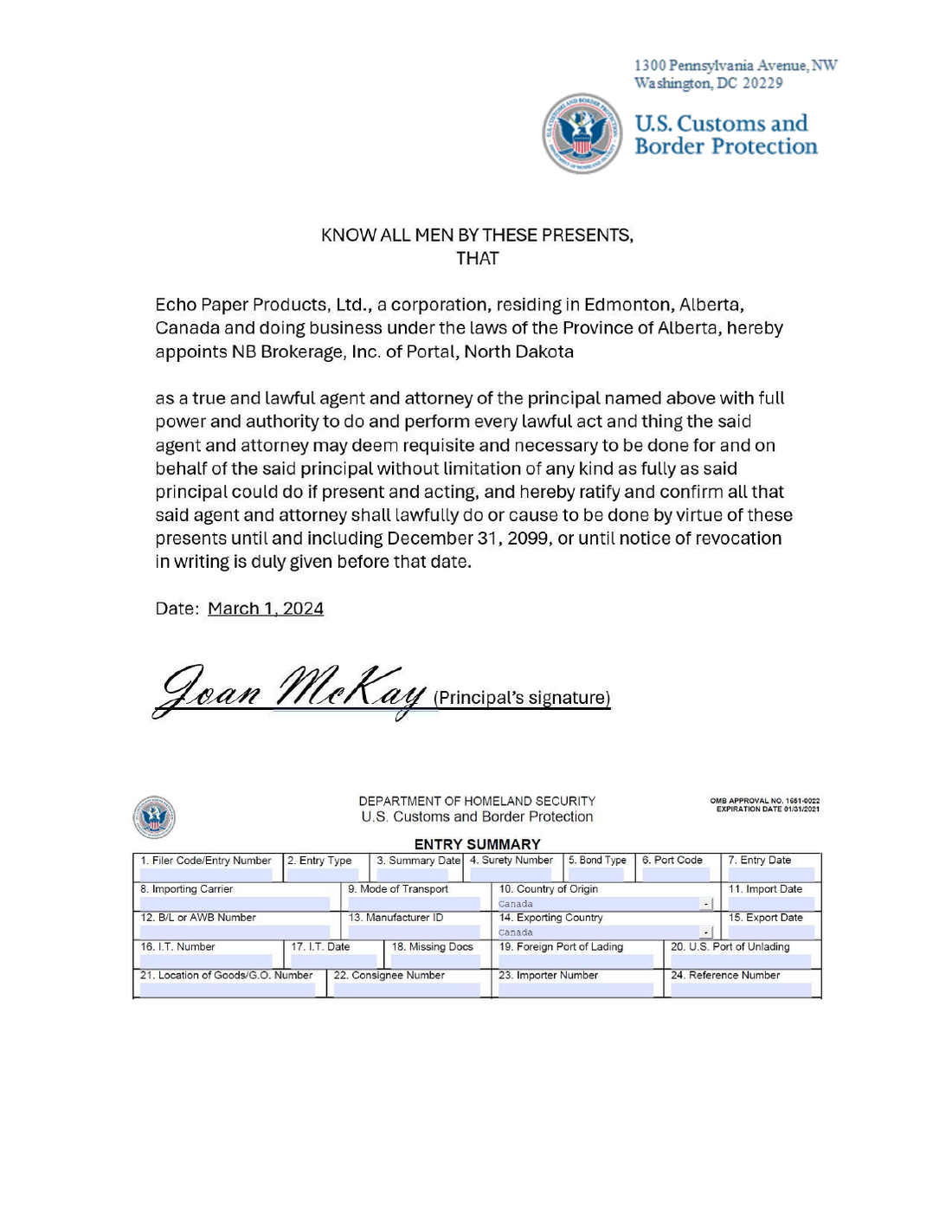
FACTS: Echo Paper Products Ltd. (Echo) of Edmonton, Alberta, Canada, has hired NB Brokerage, Inc. (NBB) of Portal, North Dakota, to file its import entries with U.S. CBP. Echo’s President is David Smith. Echo’s Vice President of Compliance is Joan McKay. Echo is a registered corporation in Alberta, Canada. Echo is not registered in any state in the United States. NBB provided a Power of Attorney for Echo to sign pursuant to 19 CFR 141.32. Joan McKay signed the POA on behalf of Echo. In Alberta, Echo manufactures uncoated paper products using Canadian origin paper pulp. Echo will be importing the uncoated paper into the United States for resale to vendors who provide self-print photographs equipment to be used by consumers. The Harmonized Tariff Schedule of the U.S. (HTSUS) classification for the uncoated paper Echo is importing is subheading 4802.56.6000, HTSUS. Echo produces and exports to the U.S. the same kind of uncoated paper products that, if imported from Australia and of Australian origin, are subject to anti-dumping (AD) duties under AD case number A-602-807. However, there is no AD case for uncoated paper products imported into the U.S. from Canada that are of Canadian origin. Echo has rented warehouse space from a North Dakota warehouse where Echo contractors repackage the paper into smaller quantities to ship to Echo’s U.S.-based clients. Echo advises NBB that it may need to re-export paper to meet demand in Canada. NBB determines it needs to make a USMCA post-summary claim on a type 01 consumption entry filed on behalf of Echo. Of the following methods for making post-summary claims, which ONE cannot be used to make a post-summary claim under the USMCA?
- File a post-summary claim under 19 USC 1520(d).
- File a post-summary correction (PSC). ✓
- File a reconciliation entry as long as the originally filed entry was flagged for FTA reconcilation.
- File a protest under 19 USC 1514 after the entry liquidates.
Why: A post-summary correction cannot be used to make a USMCA preference claim that was not made at entry; ACE BRPD Chapter 6 excludes post-importation preference claims from the PSC process because Congress created a dedicated remedy. The available routes are a post-importation claim under 19 U.S.C. 1520(d) as implemented by 19 CFR 182.31 ("the importer of that good may file a claim for a refund of any excess customs duties at any time within one year after the date of importation"), reconciliation where the entry was flagged, or a protest under 19 U.S.C. 1514 and 19 CFR 174.11 after liquidation. Option B is therefore the method that cannot be used.
You have received a “documents required” notification after the entry summary was filed. In reviewing the invoice, you handwrite additional information on the invoice to provide all required information, including the addition to the description of the bedspreads that the bedspread contains edging. Which ONE of the regulations listed below contains the requirement that prompted you to change the description as shown on the invoice provided?
- 19 CFR 141.86(a)(3)
- 19 CFR 141.86(h)(3)
- 19 CFR 141.89(a) ✓
- 19 CFR 142.6(a)(4)
Why: 19 CFR 141.89(a) prescribes additional invoice information for certain classes of merchandise, and for "Bed linen and Bedspreads" it requires a "[s]tatement as to whether or not the article contains any embroidery, lace, braid, edging, trimming, piping or applique work." Adding to the invoice that the bedspread contains edging is exactly that requirement, so 19 CFR 141.89(a) is the provision that prompted the change. 19 CFR 141.86 lists the *general* contents required of every invoice and 19 CFR 142.6 addresses the invoice required for entry - neither imposes this commodity-specific edging statement.
An entry liquidates on September 10 with a refund of excessive duties due to the importer of record. Under 19 CFR 24.36, by when must the refund, including any interest, be paid, and what follows if it is not?
- Within 30 days of liquidation; the refund is delinquent and accrues interest ✓
- Within 30 days of liquidation; the refund is delinquent but accrues no interest
- Within 60 days of liquidation; the refund is delinquent and accrues interest
- Within 90 days of liquidation; the refund is delinquent but accrues no interest
Why: Payment timing comes from 19 CFR 24.36(a)(2), which requires a refund determined to be due upon liquidation or reliquidation, including a refund consisting only of accrued interest, to be paid within 30 days of the date of liquidation or reliquidation. 19 CFR 24.36(a)(3) then makes an unpaid refund delinquent thereafter, with interest under 19 U.S.C. 1505(d) accruing on the unpaid balance by 30-day periods until the full balance is paid. That same paragraph carries two carve-outs an open-book reader should note: no interest accrues during the 30-day period in which the refund is paid, and none accrues where CBP timely certified an electronic refund but could not deliver it solely because the recipient failed to supply banking information.
CBP issues a bill for vessel repair duties. Under 19 CFR 24.3a, how is the late payment date appearing on that bill determined?
- It is the date 15 calendar days after the interest computation date
- It is the date 30 calendar days after the interest computation date ✓
- It is the date 30 calendar days after liquidation of the vessel entry
- It is the date 60 calendar days after the date the bill is received
Why: Bills for vessel repair duties, reimbursable services, and miscellaneous amounts are handled by 19 CFR 24.3a(b)(1), which provides that the late payment date is the date 30 calendar days after the interest computation date, and that the interest computation date is initially the bill date. The competing 15-day figure comes from 19 CFR 24.3a(b)(3), re-read here, and applies only where a depository bank notifies CBP by debit voucher of a dishonored payment. Matching the interval to the type of bill, rather than reciting a single number, is what the item tests.
The other subject areas
How Manifest Prep compares
Manifest is a $49 bank built on CBP's recent published exams, not a taught course. Here is how it compares with the CBLE courses candidates usually consider, including where they are the better choice. See the comparison with Global Training Center, ST&R, LACBFFA exam preparation course and others.